Building Resilient Beliefs: A Brain-Boosting Practice for Kids

Children are naturally curious about the world around them, and their brains are built to learn. With every experience, their experience of the world is being shaped. So what happens when we intentionally practice the feelings and beliefs that support them in becoming resilient, confidant, or even self-compassionate?
Their brains begin to treat those as familiar and known experiences.
That’s the opportunity behind the Creating Possibilities Protocol (CPP; Truitt, 2022)—a simple, brain-based practice that helps kids (and adults!) strengthen supportive emotional states like calm, confidence, or happiness, and reinforce beliefs like “I am safe” or “I can do hard things.”
Whether you’re starting here or building on the G.R.O.W. exercise (Truitt, 2024; a reflection-based anchor practice I introduced in my last blog), CPP helps take those inner resources and make them feel accessible and real.
How the Creating Possibilities Protocol Works
This Healing in Your Hands tool blends imagination, movement, and mindful touch to reinforce emotional learning. It’s fun, playful, and rooted in neuroscience.
Here’s how to guide it:
1. Choose a Feeling or Belief to Strengthen
Ask the child:
- “How would you like to feel right now?”
- “Is there a belief you want to practice today?”
Some common answers we see are: brave, happy, kind, strong, calm, safe.
If they’ve already done the G.R.O.W. exercise, start with the emotion or value they explored. If not, let this be the first step—no experience necessary!
2. Recall or Imagine That Feeling
Invite the child to remember a time they felt that way—or act out what it would be like. They can also imagine being a superhero, animal, or person they admire.
Let their creativity lead. If it feels good or fun, it’s working.
3. Engage the Body
Now bring the feeling into the body:
- Superhero pose
- Gentle smile
- Deep breath
- Hug or arms out wide
Movement activates the somatosensory system and supports brain-body integration. It helps the nervous system start to embody the emotional state we’re cultivating.
4. Encourage neuroplasticity by engaging Mindful Touch
Using mindful touch (rubbing palms or giving oneself a moving self-hug), guide them through three phases:
- “What if I was ___?”
Say it 5 times with curiosity. Invite silliness and imagination. (e.g., “What if I was brave like a tiger?”) - “I can be ___!”
If they start to feel the shift, repeat this 5 times to support the belief taking hold. - “I am ___!”
When it feels true, say it 5 times to reinforce and embody it.
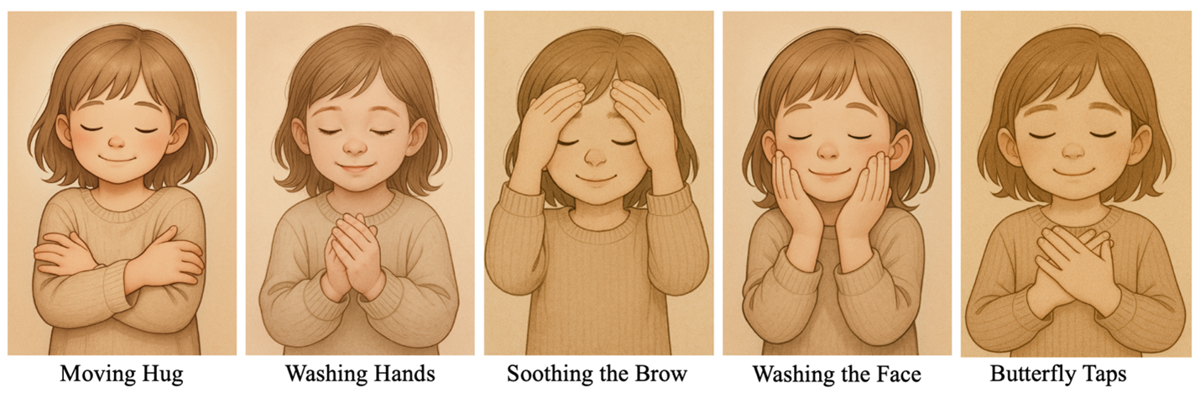
If it doesn’t feel quite real yet, circle back to “What if?” There’s no rush. We’re working with the brain, not pushing against it.
5. Pause and Reflect
Ask:
- “What do you notice in your body now?”
- “What feels different from when we started?”
- “What would it be like to carry this feeling into your next activity?”
These reflection moments invite integration—and they tell the brain: this is important.
Why the Creating Possibilities Protocol Works
The Creating Possibilities Protocol helps children build neural pathways that support emotional regulation, resilience, and empowered identity. It’s grounded in the science of neuroplasticity—the brain’s ability to change based on what we repeat with intention.
Each time we revisit a positive emotion or belief, we reinforce it. Over time, these experiences become more than ideas—they become well-worn neural trails the brain can return to, especially in moments of stress or challenge.
Want to Go Deeper?
If the child already has a special memory, feeling, or symbol they’ve connected with using the G.R.O.W. practice (Truitt, 2024; 2025), that’s a perfect place to begin. Think of it like this: G.R.O.W. plants the seed, and CPP helps it grow strong. One anchors the moment of resilience; the other helps that resilience become second nature.
Citations:
Truitt, K. (2022). Healing in Your Hands: Self-Havening Practices to Harness Neuroplasticity, Heal Traumatic Stress, and Build Resilience. PESI Publishing & Media.
Truitt, K. (2024, January 12) Healing in Your Hands with Self-Havening Workshop: Harnessing Neuroplasticity to Heal Traumatic Stress and Build Resilience with Dr. Kate Truitt. (Online Workshop conducted via Zoom).
Truitt, K. (2025, January). The Foundational Training in the NeuroTriad Model [Professional training workshop]. The Truitt Institute. Conducted via Zoom.
Healing in Your Hands is the first book of its kind to integrate the neuroscience of trauma with cutting-edge research on self-havening.


Dr. Kate Truitt, a clinical psychologist, applied neuroscientist, and international bestselling author, is an expert in trauma, stress, and resilience. She is the founder of the educational platform Truitt Institute and leads her award-winning clinical team at Dr. Kate Truitt & Associates. As a member of the Goldie Hawn Foundation’s MindUP Scientific Advisory Committee and a co-developer of the Havening Techniques®, as well as an expert contributor to the Kevin Love Fund and Girl Scouts of America, Dr. Truitt passionately advocates for mental health literacy and personal empowerment globally. Her voice in the mental health arena extends to her role as a speaker and media consultant, including being featured in BBC and Today, and speaking at prestigious platforms like the United Nations and the United States Department of Defense. Dr. Truitt founded and is the chairman of the board for the Amy Research Foundation, a 501c3 organization focused on advancing research into the innovative treatment realm of neuroscience-based mental health and wellness interventions. As the author of her memoir, #1 top new release Keep Breathing: A Psychologist’s Intimate Journey Through Loss, Trauma, and Rediscovering Life and the international bestseller Healing in Your Hands: Self-Havening Exercises to Harness Neuroplasticity, Heal Traumatic Stress, and Build Resilience, she is dedicated to advancing the treatment of traumatic stress while making significant strides in destigmatizing mental health and fostering resilience worldwide.
Speaker Disclosures:
Financial: Dr. Kate Truitt is the President and Founder of Dr. Kate Truitt & Associates; Chief Executive Officer of the Trauma Counseling Center of Los Angeles; Executive Director and Founder of the Amy Research Foundation; and Executive Director of the Truitt Institute. Dr. Truitt receives royalties as a published author and compensation as a presenter. She serves as a scientific advisor and board member for Anti-AgingGames.com and the Goldie Hawn Foundation. She also receives speaking honoraria and recording royalties from Psychotherapy Networker and PESI, Inc. All relevant financial relationships with ineligible organizations have been mitigated.
Non-financial: Dr. Kate Truitt is a member of the American Psychological Association, the Association for Psychological Science, the American Association for the Advancement of Science, the International Society for Traumatic Stress Studies, the American Cognitive Training Association, and the American College of Healthcare Executives.


