Going Virtual with Couples
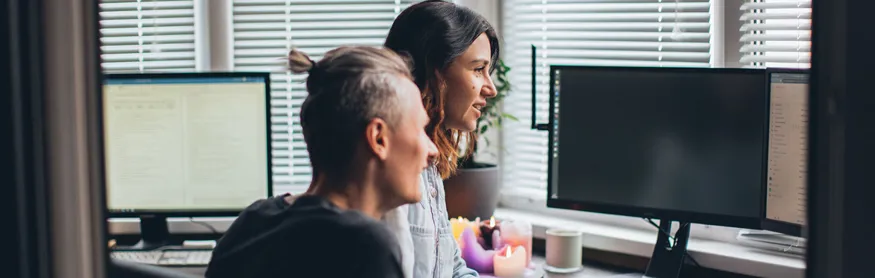

My first response to the idea that you could do therapy well online was total disbelief. Until about 18 months ago, I simply refused to consider it. But I remember the day when my colleague’s voice became strident and she practically yelled at me, “Look, I know you don’t do online therapy, Sue. But if you don’t take this couple, they’ll split up and he’ll go back to a life of drugs. You know how to deal with traumatized couples, and they have no resources—none. They live in the high Arctic. Please just do it!”
I took a deep breath. “You want me to do my first online case ever with a trauma couple in relationship distress when the more withdrawn partner is facing relapse into serious addiction? That’s like jumping in the deep end at your first swimming class.” She agreed that it was. So I took the case!
The next morning all my reservations began to echo in my head. I’m a klutz when it comes to technology, so this makes online therapy intimidating in itself. I’d heard my colleagues worry about how secure and confidential online “platforms” were, and I didn’t even really know what a platform was!
I’d also spent the last few years committed to the belief that our obsession with everything online was destroying our ability to be intimate, to really connect. My heart would sink as I watched couples in restaurants giving at best half their attention to their partner and half to their phone, or as another fight started with my adult children to get them to put their phones away when they visited me. Now I was going to rely on this technology to convey the potent messages I was counting on to change a couple’s lives?
By noon I’d progressed to more specific reservations. Maybe talking to one client could work online, but working with a couple meant managing several relationships at once: between me and each partner and between the two of them. It seemed like too much to me. Also, since I work with emotions, could I tune into and track them with the same accuracy on a screen? Could I get the same emotional depth and intensity going when I wasn’t actually in the room? I was used to touching people to ground and comfort them, how could I do that online? And how could I direct a session when I was just a figure on a flat screen?
By 4 p.m., I’d found an online permission form, emailed it to the couple, checked with my professional college about their rules for online therapy, and, with the help of a tech-savvy colleague, arranged to do something called Zoom with Mary and Cole.
Before our session, I’d asked them to send me a short summary of how they each saw their relationship and what they believed had to change for them to be happier together. Mary’s version was three times longer than Cole’s. Both of them were Inuit, but Mary had lived much of her early life down south and had returned to the north to take a job as a nurse in the local clinic. Cole worked in construction and also made money as a hunter out on the polar ice.
When Cole was five years old, his father died. Eventually, like many in his family, he became caught in a spiral of addiction to alcohol and drugs. There was considerable intergenerational trauma: Cole’s parents and grandparents had been forcibly removed from their families and communities and sent to religious residential schools where physical and sexual abuse were rampant. In contrast, Mary reported a stable family life and a close attachment to her father, but she’d experienced a traumatizing romantic attachment as a young woman. In this relationship, she’d been physically abused and ended up charging her partner with assault. Luckily, there’d never been any hint of this kind of abuse in her relationship with Cole.
Mary and Cole had been together for 12 years, and Cole had recently gone south to a residential addiction program to prevent Mary carrying out her threat of leaving him. Previously, when they’d separated for a brief time, Cole had become very depressed and suicidal. Mary reported that he was now sober and no longer flipping into fits of rage. But she added that he’d routinely shut her out when she tried to talk about their relationship issues and how she wanted to start a family. She’d read my book Hold Me Tight and understood that her need to talk things out was sometimes too much for Cole, but she also wrote that “once he’s shut down, he’s gone, gone. I can’t get to him at all. I don’t trust him. He lies about his relapses, and I just can’t stand it anymore.”
Cole stated that his mind goes blank at times of conflict, and that he used to escape by going hunting on the ice for days at a time. They both stated that they fought over money and the fact that Mary doesn’t trust Cole to be honest with her and stay sober. (He agreed that he was not really “open” with her.) Cole shared that he realized how he was wounded as a kid by the habitual violence and addictive behaviors of his family members. His main memory of his childhood was how the family would all chant “suck it up, buttercup” to him. Mary ended her letter to me by saying, “I don’t trust him, so I nag and push him, and he shuts me out.”
Reading these letters, I reflected that I knew this dance of distress pretty well, and after so many studies and so much experience, I trusted the Emotionally Focused Therapy (EFT) model, online or off, to help me take this couple into more secure connection.
Zooming into Therapy
In the first session, my priority was to create a safe-haven alliance with both partners. Attuning to this couple on the screen was surprisingly easy, at least with Mary. She was agitated but clear that she wanted to feel “safer and closer” with her partner. Cole, however, as a naturally introverted and silent man, was harder to connect with. He was very still and slow to look up at me when answering any of my questions. I asked myself if this was about our socialization on a screen, which was normally to just sit and watch as a spectator. But I decided that it was simply his temperament, his culture, and his position as a withdrawer in this relationship. So I did what I’d normally do: hit the brakes and slowed my pacing, telling myself that joining a client where they are and respecting their way of being was just the way we did EFT, period.
As I tuned in, I began to viscerally pick up on his fear. Therapy was an alien place for this man. Perhaps it was an advantage that he was at least in his own home with his slippers on and not in my office. Perhaps it was actually safer for him that I was only a figure on a screen!
Already, in the first session, I noticed that I had to make small adaptations to this new, flat world—a visual world. I made sure that my face was well lit and the background was uncluttered. But Cole had a habit of turning his swivel chair away from me. I really needed to make sure I could see his face, so I had to explain this and ask him to turn toward me a few times. I also had to tell Mary in a more directive way than usual that, because she spoke fast and liked to explain things in detail, I needed to stop her when I became confused. We agreed that when I put my palm up to the screen she’d pause, take a breath, and wait for me to speak. That way, I could pay more attention to visual cues and set up a structure so I could control the interactions in the session.
This was all good and reassuring, but the real question for me about online therapy was still whether I could evoke the absorbing engagement—the tent of trancelike attention and stepping into deeper levels of experience—that characterized a good session for me. This would be a challenge using a medium where bursts of attention are often short and distraction is rampant. At one point, Cole picked up his pug, called Wheezy, and plopped him on his lap. When Wheezy looked me squarely in the eye and began to snort, my first response was to freak out. I thought, I’m giving this online thing a shot, but this is too much. Besides, I hate pugs! However, I recognized from the way Cole gripped his dog that Wheezy was a kind of security blanket. And so I had to learn to do EFT online not just to the music of emotion, but to the enchanting rhythm of animal wheezes and snorts.
In spite of all this, I felt encouraged after the first session. I’d read a comment in The New York Times where someone had likened online sessions to doing therapy with a condom on, but I found it was surprisingly intimate in some ways. After all, I was talking from my home—at one point my own dog had burst into the room, sending Wheezy into asphyxia—and I was Zooming into my clients’ living room. I could see their family photos on the shelf, and they began the session by finishing their lunch sandwiches.

I found that, just as in in-person sessions, I could tune into and evoke each person’s expressions of pain and isolation. I could begin to shape that state of engaged exploration where change happens in EFT.
Cole’s voice became very quiet when I asked him what he’d like to happen in our sessions. He murmured, “I want to be her rock, but I hide and I lie so I don’t get in trouble, and I don’t reach for her ever. All I know is to suck it up: that’s what I learned growing up, and that’s all I know how to do.” I validated that this hiding and silence had been the only route to survival for him and his family.
Just as I imagine would happen if we were all in my office, when I softly and slowly asked evocative questions, Mary moved into the fear and panic that came for her when Cole shut her out. I framed how their dance of critical advice and probing followed by evasion and withdrawal devastated them both. I named this dance as the problem and helped Mary tell Cole directly, “I can’t trust and be safe when I can’t see you. Then my fear turns to rage. If you were open with me, I could forgive.” When we finished the session, I did a hands-in-prayer bow to them, and Mary opened and closed her arms in a virtual hug.
A Different Online Engagement
As our sessions went on, I found that when using the EFT model, focusing on potent attachment signals and patterns of closeness and distance, and on the core emotional music defining a couple’s dance, therapy could still be up close and personal. Shaping emotional engagement in the moment and deepening emotion seemed especially crucial, compensating for the more impersonal online format. In the fourth session, for example, Cole shut down on me and would only repeat, “Quiet is best, otherwise trouble.”
We’ve learned in EFT to assemble emotion systematically and to make it “granular,” as Lisa Feldman Barrett says. What’s specific and clear can be felt, regulated, ordered, and explored. So I unpacked the vague-word problem with Cole using RISSSC. In other words, I tried to Reflect/Repeat his words, use Images, keep things Simple, make my voice Soft and Slow, and use the Client’s words to pinpoint emotional handles that might open up his inner world. We laid out his fear that if he doesn’t shut down, he’ll hear a “crushing” message that would feel like a huge weight on his chest, stealing his breath. He’ll hear Mary’s disgust for him. Panic will flood in, then the words “I’m not good enough to be loved—ever.” A sense of helplessness will come next, and he’ll run to numb out, finding an escape in a drug or a drink.
As we always do in EFT, I worked to bring core emotions alive in the session, open them up to the light, and use the new, clarified emotion to send new signals to the other partner, changing the attachment drama in the relationship. I guided Cole to tell Mary, “When I hear that disappointment in your voice, I can’t breathe. I’m crushed, a worthless child again, always mocked and bruised. Helpless. So I go away.”
She turned to him, weeping, and whispered, “Well, I want you. You are my only one. I’m fighting for you, desperate for you to let me in.” We’re all wired for connection, and bonding moments like these surge through our nervous system and make it sing. I don’t have to be physically in the room for this—I just have to know how to tune in and shape a natural bonding process.
Cole and Mary began to clearly see their negative cycle of disconnection and how this constantly triggered Cole into flirting with relapse. All problems with how we deal with our vulnerabilities and anxieties are turned on, up, or off by the interactions we have with our loved ones. So I remembered to go slowly and slice risks very thin with Cole, and he slowly emerged from his silence and shame, while Mary was able to move under her anger and touch her deep grief and sense of abandonment by Cole. They named their negative dance the Panic Polka and moved into stage two of EFT: restructuring their attachment bond.
Attachment Moments
In the second stage, I was again pleased to notice that our online sessions played out pretty much the same way they might in my office. We discovered that as kids, both partners had learned that it was dangerous to turn toward others and show vulnerability. For Mary, this was the result of her relationship with a highly critical and distant mother, compensated for by a positive relationship with her father and the therapy she’d done years before meeting Cole.
Cole grew up in a traumatized and marginalized family, with a mother consumed by her own pain, and uncles who physically abused him and belittled him for any sign of frailty or need. Nevertheless, as he began to trust me, he became more and more engaged in our sessions. Just one time he blurted out that he was overwhelmed and needed to leave the session. I validated that his ability to run and shut down had saved his life in the past, and that I was glad he spoke up about how he was feeling. We ended the session early that day, and afterward, he seemed to relax into the therapy process.
In the next session, he was able to weep and tell Mary that he’d always believed he was “just plain bad and a burden,” but that he longed for her love and forgiveness. He knew how he’d almost thrown her love away by turning to pills and booze. We tuned into a pivotal attachment moment when he’d come home after drinking with his buddies, terrified and sick with disgust at himself, and reach for what he called his “hiding mask.” We agreed that this mask looked like what attachment researchers have termed still face, where the face is held completely flat and still, communicating, I can shut you out; I’m impervious and unreachable. This reliably triggers attachment panic and separation distress for the other person in an attachment relationship.
Mary responded to his openness by sharing that at these moments, when he had his hiding mask on, she’d feel helpless and lost, knowing that anything she said would trigger his total withdrawal from her, but finding herself screaming in protest anyway. Cole stayed engaged and turned to her, softly asking, “What do you want me to do right then?”
Mary replied, “I want to be important enough that you’ll risk being open with me and just tell me that you’ve slipped. I can accept that if you can let me in. I can’t keep losing you to your addiction. It terrifies me.” This was the beginning of their “hold me tight conversation,” as we say in EFT.
When we next met on the screen, Cole appeared beaming. He told me, “I woke up; that last session woke me up. I got that she needs me, and I don’t want to scare her away. So this week when the boys asked me to go with them to drink, I called her and said part of me just ached to go but I was coming home!” Mary wept and confided that it was excruciating for her to ask for what she needed, but indeed she needed him and his “gentle soul.” I noticed that Cole even began to loosen his grip on Wheezy and actually placed him down on the floor during our last sessions.
A few months later, we had a catch-up call, and the couple reported that they were doing well. Cole was still sober, and he was even helping other men in his community learn about how to step away from addiction. He added that he was beginning to be able to “take Mary’s love in.” They’d decided that they could handle the future together, and Mary was pregnant!
Therapy as Usual?
What did I do with Cole and Mary that was different from therapy as usual? I did have to take care of technical issues, like ensuring that the light in the room allowed me to see each person’s face clearly. Knowing that for this couple I was a flat image on a screen, I believe I was deliberately more explicit in my statements. I repeated myself more and checked out my sense of what was happening for each partner more often. I think my gestures were a little bigger than usual, and I used my voice, pacing, and tone more consciously. I was generally more aware of the need to be super present and focused, and to bring each partner’s emotions and the stuck places in their negative dance fully alive. So perhaps, I was almost a heightened therapist.
When the screen froze a few times, I simply picked up where we left off with processes like assembling emotion or shaping new kinds of interactions. It wasn’t long before all the anxiety and doubt about doing online therapy—especially using a process-oriented, emotionally focused approach—evaporated.
Would online interventions have been harder if the couple had been highly escalated and difficult to direct in session? Probably. These kinds of couples are often the hardest to work with in person as well. Since seeing Mary and Cole, I’ve been using EFT in individual sessions with depressed, anxious, and traumatized clients online. Is individual EFT (EFIT) easier to implement online than EFT for couples? Generally, it seems to be a little easier, but again, in-person couples therapy is often more demanding than in-person individual therapy. Dealing with two clients and how their worlds collide usually takes more effort than dealing with a single person in session.
- - - -
All this happened before the COVID-19 pandemic, and I’m grateful that I became at least a little familiar with doing online EFT before this crisis hit. It meant that instead of hugging my insecurity to my chest, I was able to dive into the deep end and reach people on-screen. Obviously, people need access to therapy now more than ever, and online is often the only possibility.
This pandemic has traumatized so many of us. It’s also robbed us of the sources of comfort and support that allow us to cope with trauma—our routines, job security, friends, family. Depression, anxiety disorders, traumatic stress problems, relationship breakdown, and domestic violence continue to rise. We must find as many ways to reach and support people as we can, and I realize now that online interventions have to be part of the therapist’s toolbox.
The same colleague who’d initially pushed me to see Mary and Cole online expressed to me recently how much she was looking forward to seeing her clients in person again. Indeed, I am too, but—as surprising as this would’ve seemed to me just last year—I’ll also continue to offer online therapy, knowing now that I can make a difference even when I’m being buzzed through a wire, one dimensional, on a screen. I can still be moved and move others into connection and the aliveness that Carl Rogers called “existential living.”
An article in The New York Times this summer by Kate Murphy dismissed Zoom as “terrible,” suggesting that it inevitably messes up communication. She argued that since nonverbal cues are hidden, we can’t mirror people’s emotions, feel them in our body, and move into empathy. This is not my experience. Therapists are trained to be able to tune in and mirror emotions—and that can happen online and off. Our medium is emotion, and that’s the most powerful communicator of all. If we know how to use it for change, maybe physical distance doesn’t matter!
***
Susan Johnson, EdD, is the developer of Emotionally Focused Therapy. Her latest book is Attachment Theory in Practice: Emotionally Focused Therapy (EFT) with Individuals, Couples, and Families.
Learn more about her educational products, including upcoming live seminars, by clicking here.
***
This article published in the Psychotherapy Netwoker Magazine, November/December 2020 issue.
***
PHOTO © I STOCK / PEOPLEIMAGES/ PEXELS
I took a deep breath. “You want me to do my first online case ever with a trauma couple in relationship distress when the more withdrawn partner is facing relapse into serious addiction? That’s like jumping in the deep end at your first swimming class.” She agreed that it was. So I took the case!
The next morning all my reservations began to echo in my head. I’m a klutz when it comes to technology, so this makes online therapy intimidating in itself. I’d heard my colleagues worry about how secure and confidential online “platforms” were, and I didn’t even really know what a platform was!
I’d also spent the last few years committed to the belief that our obsession with everything online was destroying our ability to be intimate, to really connect. My heart would sink as I watched couples in restaurants giving at best half their attention to their partner and half to their phone, or as another fight started with my adult children to get them to put their phones away when they visited me. Now I was going to rely on this technology to convey the potent messages I was counting on to change a couple’s lives?
By noon I’d progressed to more specific reservations. Maybe talking to one client could work online, but working with a couple meant managing several relationships at once: between me and each partner and between the two of them. It seemed like too much to me. Also, since I work with emotions, could I tune into and track them with the same accuracy on a screen? Could I get the same emotional depth and intensity going when I wasn’t actually in the room? I was used to touching people to ground and comfort them, how could I do that online? And how could I direct a session when I was just a figure on a flat screen?
By 4 p.m., I’d found an online permission form, emailed it to the couple, checked with my professional college about their rules for online therapy, and, with the help of a tech-savvy colleague, arranged to do something called Zoom with Mary and Cole.
The real question about online therapy was whether I could evoke the tent of trancelike attention that characterized a good session for me.
Before our session, I’d asked them to send me a short summary of how they each saw their relationship and what they believed had to change for them to be happier together. Mary’s version was three times longer than Cole’s. Both of them were Inuit, but Mary had lived much of her early life down south and had returned to the north to take a job as a nurse in the local clinic. Cole worked in construction and also made money as a hunter out on the polar ice.
When Cole was five years old, his father died. Eventually, like many in his family, he became caught in a spiral of addiction to alcohol and drugs. There was considerable intergenerational trauma: Cole’s parents and grandparents had been forcibly removed from their families and communities and sent to religious residential schools where physical and sexual abuse were rampant. In contrast, Mary reported a stable family life and a close attachment to her father, but she’d experienced a traumatizing romantic attachment as a young woman. In this relationship, she’d been physically abused and ended up charging her partner with assault. Luckily, there’d never been any hint of this kind of abuse in her relationship with Cole.
Mary and Cole had been together for 12 years, and Cole had recently gone south to a residential addiction program to prevent Mary carrying out her threat of leaving him. Previously, when they’d separated for a brief time, Cole had become very depressed and suicidal. Mary reported that he was now sober and no longer flipping into fits of rage. But she added that he’d routinely shut her out when she tried to talk about their relationship issues and how she wanted to start a family. She’d read my book Hold Me Tight and understood that her need to talk things out was sometimes too much for Cole, but she also wrote that “once he’s shut down, he’s gone, gone. I can’t get to him at all. I don’t trust him. He lies about his relapses, and I just can’t stand it anymore.”
Cole stated that his mind goes blank at times of conflict, and that he used to escape by going hunting on the ice for days at a time. They both stated that they fought over money and the fact that Mary doesn’t trust Cole to be honest with her and stay sober. (He agreed that he was not really “open” with her.) Cole shared that he realized how he was wounded as a kid by the habitual violence and addictive behaviors of his family members. His main memory of his childhood was how the family would all chant “suck it up, buttercup” to him. Mary ended her letter to me by saying, “I don’t trust him, so I nag and push him, and he shuts me out.”
Reading these letters, I reflected that I knew this dance of distress pretty well, and after so many studies and so much experience, I trusted the Emotionally Focused Therapy (EFT) model, online or off, to help me take this couple into more secure connection.
Zooming into Therapy
In the first session, my priority was to create a safe-haven alliance with both partners. Attuning to this couple on the screen was surprisingly easy, at least with Mary. She was agitated but clear that she wanted to feel “safer and closer” with her partner. Cole, however, as a naturally introverted and silent man, was harder to connect with. He was very still and slow to look up at me when answering any of my questions. I asked myself if this was about our socialization on a screen, which was normally to just sit and watch as a spectator. But I decided that it was simply his temperament, his culture, and his position as a withdrawer in this relationship. So I did what I’d normally do: hit the brakes and slowed my pacing, telling myself that joining a client where they are and respecting their way of being was just the way we did EFT, period.
As I tuned in, I began to viscerally pick up on his fear. Therapy was an alien place for this man. Perhaps it was an advantage that he was at least in his own home with his slippers on and not in my office. Perhaps it was actually safer for him that I was only a figure on a screen!
Already, in the first session, I noticed that I had to make small adaptations to this new, flat world—a visual world. I made sure that my face was well lit and the background was uncluttered. But Cole had a habit of turning his swivel chair away from me. I really needed to make sure I could see his face, so I had to explain this and ask him to turn toward me a few times. I also had to tell Mary in a more directive way than usual that, because she spoke fast and liked to explain things in detail, I needed to stop her when I became confused. We agreed that when I put my palm up to the screen she’d pause, take a breath, and wait for me to speak. That way, I could pay more attention to visual cues and set up a structure so I could control the interactions in the session.
This was all good and reassuring, but the real question for me about online therapy was still whether I could evoke the absorbing engagement—the tent of trancelike attention and stepping into deeper levels of experience—that characterized a good session for me. This would be a challenge using a medium where bursts of attention are often short and distraction is rampant. At one point, Cole picked up his pug, called Wheezy, and plopped him on his lap. When Wheezy looked me squarely in the eye and began to snort, my first response was to freak out. I thought, I’m giving this online thing a shot, but this is too much. Besides, I hate pugs! However, I recognized from the way Cole gripped his dog that Wheezy was a kind of security blanket. And so I had to learn to do EFT online not just to the music of emotion, but to the enchanting rhythm of animal wheezes and snorts.
In spite of all this, I felt encouraged after the first session. I’d read a comment in The New York Times where someone had likened online sessions to doing therapy with a condom on, but I found it was surprisingly intimate in some ways. After all, I was talking from my home—at one point my own dog had burst into the room, sending Wheezy into asphyxia—and I was Zooming into my clients’ living room. I could see their family photos on the shelf, and they began the session by finishing their lunch sandwiches.

I had to learn to do EFT online not just to the music of emotion, but to the enchanting rhythm of animal wheezes and snorts.
I found that, just as in in-person sessions, I could tune into and evoke each person’s expressions of pain and isolation. I could begin to shape that state of engaged exploration where change happens in EFT.
Cole’s voice became very quiet when I asked him what he’d like to happen in our sessions. He murmured, “I want to be her rock, but I hide and I lie so I don’t get in trouble, and I don’t reach for her ever. All I know is to suck it up: that’s what I learned growing up, and that’s all I know how to do.” I validated that this hiding and silence had been the only route to survival for him and his family.
Just as I imagine would happen if we were all in my office, when I softly and slowly asked evocative questions, Mary moved into the fear and panic that came for her when Cole shut her out. I framed how their dance of critical advice and probing followed by evasion and withdrawal devastated them both. I named this dance as the problem and helped Mary tell Cole directly, “I can’t trust and be safe when I can’t see you. Then my fear turns to rage. If you were open with me, I could forgive.” When we finished the session, I did a hands-in-prayer bow to them, and Mary opened and closed her arms in a virtual hug.
A Different Online Engagement
As our sessions went on, I found that when using the EFT model, focusing on potent attachment signals and patterns of closeness and distance, and on the core emotional music defining a couple’s dance, therapy could still be up close and personal. Shaping emotional engagement in the moment and deepening emotion seemed especially crucial, compensating for the more impersonal online format. In the fourth session, for example, Cole shut down on me and would only repeat, “Quiet is best, otherwise trouble.”
We’ve learned in EFT to assemble emotion systematically and to make it “granular,” as Lisa Feldman Barrett says. What’s specific and clear can be felt, regulated, ordered, and explored. So I unpacked the vague-word problem with Cole using RISSSC. In other words, I tried to Reflect/Repeat his words, use Images, keep things Simple, make my voice Soft and Slow, and use the Client’s words to pinpoint emotional handles that might open up his inner world. We laid out his fear that if he doesn’t shut down, he’ll hear a “crushing” message that would feel like a huge weight on his chest, stealing his breath. He’ll hear Mary’s disgust for him. Panic will flood in, then the words “I’m not good enough to be loved—ever.” A sense of helplessness will come next, and he’ll run to numb out, finding an escape in a drug or a drink.
As we always do in EFT, I worked to bring core emotions alive in the session, open them up to the light, and use the new, clarified emotion to send new signals to the other partner, changing the attachment drama in the relationship. I guided Cole to tell Mary, “When I hear that disappointment in your voice, I can’t breathe. I’m crushed, a worthless child again, always mocked and bruised. Helpless. So I go away.”
She turned to him, weeping, and whispered, “Well, I want you. You are my only one. I’m fighting for you, desperate for you to let me in.” We’re all wired for connection, and bonding moments like these surge through our nervous system and make it sing. I don’t have to be physically in the room for this—I just have to know how to tune in and shape a natural bonding process.
Cole and Mary began to clearly see their negative cycle of disconnection and how this constantly triggered Cole into flirting with relapse. All problems with how we deal with our vulnerabilities and anxieties are turned on, up, or off by the interactions we have with our loved ones. So I remembered to go slowly and slice risks very thin with Cole, and he slowly emerged from his silence and shame, while Mary was able to move under her anger and touch her deep grief and sense of abandonment by Cole. They named their negative dance the Panic Polka and moved into stage two of EFT: restructuring their attachment bond.
Attachment Moments
In the second stage, I was again pleased to notice that our online sessions played out pretty much the same way they might in my office. We discovered that as kids, both partners had learned that it was dangerous to turn toward others and show vulnerability. For Mary, this was the result of her relationship with a highly critical and distant mother, compensated for by a positive relationship with her father and the therapy she’d done years before meeting Cole.
Cole grew up in a traumatized and marginalized family, with a mother consumed by her own pain, and uncles who physically abused him and belittled him for any sign of frailty or need. Nevertheless, as he began to trust me, he became more and more engaged in our sessions. Just one time he blurted out that he was overwhelmed and needed to leave the session. I validated that his ability to run and shut down had saved his life in the past, and that I was glad he spoke up about how he was feeling. We ended the session early that day, and afterward, he seemed to relax into the therapy process.
In the next session, he was able to weep and tell Mary that he’d always believed he was “just plain bad and a burden,” but that he longed for her love and forgiveness. He knew how he’d almost thrown her love away by turning to pills and booze. We tuned into a pivotal attachment moment when he’d come home after drinking with his buddies, terrified and sick with disgust at himself, and reach for what he called his “hiding mask.” We agreed that this mask looked like what attachment researchers have termed still face, where the face is held completely flat and still, communicating, I can shut you out; I’m impervious and unreachable. This reliably triggers attachment panic and separation distress for the other person in an attachment relationship.
Mary responded to his openness by sharing that at these moments, when he had his hiding mask on, she’d feel helpless and lost, knowing that anything she said would trigger his total withdrawal from her, but finding herself screaming in protest anyway. Cole stayed engaged and turned to her, softly asking, “What do you want me to do right then?”
Mary replied, “I want to be important enough that you’ll risk being open with me and just tell me that you’ve slipped. I can accept that if you can let me in. I can’t keep losing you to your addiction. It terrifies me.” This was the beginning of their “hold me tight conversation,” as we say in EFT.
When we next met on the screen, Cole appeared beaming. He told me, “I woke up; that last session woke me up. I got that she needs me, and I don’t want to scare her away. So this week when the boys asked me to go with them to drink, I called her and said part of me just ached to go but I was coming home!” Mary wept and confided that it was excruciating for her to ask for what she needed, but indeed she needed him and his “gentle soul.” I noticed that Cole even began to loosen his grip on Wheezy and actually placed him down on the floor during our last sessions.
A few months later, we had a catch-up call, and the couple reported that they were doing well. Cole was still sober, and he was even helping other men in his community learn about how to step away from addiction. He added that he was beginning to be able to “take Mary’s love in.” They’d decided that they could handle the future together, and Mary was pregnant!
Therapy as Usual?
What did I do with Cole and Mary that was different from therapy as usual? I did have to take care of technical issues, like ensuring that the light in the room allowed me to see each person’s face clearly. Knowing that for this couple I was a flat image on a screen, I believe I was deliberately more explicit in my statements. I repeated myself more and checked out my sense of what was happening for each partner more often. I think my gestures were a little bigger than usual, and I used my voice, pacing, and tone more consciously. I was generally more aware of the need to be super present and focused, and to bring each partner’s emotions and the stuck places in their negative dance fully alive. So perhaps, I was almost a heightened therapist.
When the screen froze a few times, I simply picked up where we left off with processes like assembling emotion or shaping new kinds of interactions. It wasn’t long before all the anxiety and doubt about doing online therapy—especially using a process-oriented, emotionally focused approach—evaporated.
Would online interventions have been harder if the couple had been highly escalated and difficult to direct in session? Probably. These kinds of couples are often the hardest to work with in person as well. Since seeing Mary and Cole, I’ve been using EFT in individual sessions with depressed, anxious, and traumatized clients online. Is individual EFT (EFIT) easier to implement online than EFT for couples? Generally, it seems to be a little easier, but again, in-person couples therapy is often more demanding than in-person individual therapy. Dealing with two clients and how their worlds collide usually takes more effort than dealing with a single person in session.
- - - -
All this happened before the COVID-19 pandemic, and I’m grateful that I became at least a little familiar with doing online EFT before this crisis hit. It meant that instead of hugging my insecurity to my chest, I was able to dive into the deep end and reach people on-screen. Obviously, people need access to therapy now more than ever, and online is often the only possibility.
This pandemic has traumatized so many of us. It’s also robbed us of the sources of comfort and support that allow us to cope with trauma—our routines, job security, friends, family. Depression, anxiety disorders, traumatic stress problems, relationship breakdown, and domestic violence continue to rise. We must find as many ways to reach and support people as we can, and I realize now that online interventions have to be part of the therapist’s toolbox.
The same colleague who’d initially pushed me to see Mary and Cole online expressed to me recently how much she was looking forward to seeing her clients in person again. Indeed, I am too, but—as surprising as this would’ve seemed to me just last year—I’ll also continue to offer online therapy, knowing now that I can make a difference even when I’m being buzzed through a wire, one dimensional, on a screen. I can still be moved and move others into connection and the aliveness that Carl Rogers called “existential living.”
An article in The New York Times this summer by Kate Murphy dismissed Zoom as “terrible,” suggesting that it inevitably messes up communication. She argued that since nonverbal cues are hidden, we can’t mirror people’s emotions, feel them in our body, and move into empathy. This is not my experience. Therapists are trained to be able to tune in and mirror emotions—and that can happen online and off. Our medium is emotion, and that’s the most powerful communicator of all. If we know how to use it for change, maybe physical distance doesn’t matter!
***
Susan Johnson, EdD, is the developer of Emotionally Focused Therapy. Her latest book is Attachment Theory in Practice: Emotionally Focused Therapy (EFT) with Individuals, Couples, and Families.
Learn more about her educational products, including upcoming live seminars, by clicking here.
***
This article published in the Psychotherapy Netwoker Magazine, November/December 2020 issue.
***
PHOTO © I STOCK / PEOPLEIMAGES/ PEXELS
Help the couples you work with create more secure lasting bonds!

Join Dr. Susan Johnson in her intensive online course on Emotionally Focused Therapy: Attachment-based interventions for couples in crisis.
> Click here to learn the essentials of EFT!
> Click here to learn the essentials of EFT!

Susan Johnson EdD
The late Susan Johnson, EdD, was a best-selling author, clinical psychologist, distinguished research professor, dynamic speaker, and recognized innovator who changed the field of couple therapy. Sue was the primary developer of Emotionally Focused Therapy (EFT), which has demonstrated its effectiveness in over 30 years of peer-reviewed clinical research. She was the director of the International Center for Excellence in Emotionally Focused Therapy and a distinguished research professor at Alliant University in San Diego, California, as well as professor of clinical psychology at the University of Ottawa, Canada. She trained behavioral health providers in EFT worldwide and is still recognized as one of the most prominent researchers and presenters in the couple therapy field.
Speaker Disclosures:
Financial: Dr. Sue Johnson had employment relationships with University of British Columbia, Campbell & Fairweather Psychology Group, Alliant International, University Ottawa, Couple and Family Institute, and the International Center for Excellence in Emotionally Focused Therapy. She received royalties as a published author. Dr. Johnson received a speaking honorarium, recording royalties, and book royalties from PESI, Inc. She had no relevant financial relationships with ineligible organizations.
Non-financial: Dr. Sue Johnson served on the editorial board for the American Journal of Family Therapy (AJFT) and the journal Couple and Family Psychology: Research & Practice.
You May Also Be Interested In These Related Blog Posts