Helping Clients Shift Rigid Beliefs with Hakomi: Mindfulness and the Body in Trauma Healing

Therapists working with trauma often encounter clients locked into deep patterns of belief: I’m not safe, I don’t belong, I have to protect myself at all times. These core assumptions aren’t just mental. They’re physiological. They live in the nervous system and shape how our clients move through the world.
The Hakomi method offers a path for change that begins not with confrontation, but with gentle inquiry. It asks: What happens when we slow down enough to listen to the body? What might unfold when we meet our clients with presence, curiosity, and care?
Applied Mindfulness: Creating the Conditions for Transformation
In Hakomi, mindfulness isn’t used to calm or distract. It’s used to study. We invite clients into a state of quiet, curious observation where they can notice what arises without judgment. This state gives access to unconscious material like somatic memories, emotional imprints, and limiting beliefs that are often out of reach in everyday awareness.
Unlike traditional mindfulness practices that may overwhelm trauma survivors, applied mindfulness in Hakomi is always done in relationship. It is the relational field—attuned, co-regulated, and grounded—that allows clients to feel safe enough to observe their internal world.
When clients enter this mindful state, we might offer a gentle probe:
“What happens when I say, ‘You belong here’?”
What follows is not analysis, but sensation, imagery, emotion. This is the portal into the implicit memory systems that drive our clients’ most rigid mental models.
The Body as the Storyteller
The body is our greatest ally in trauma healing. It tells the stories our clients may not have words for. Tight jaws, clenched fists, collapsed postures are the expressions of long-held survival strategies.
In Hakomi, we don’t interpret or fix. We study. We help clients become curious about their own physical and emotional patterns. When a client clenches their chest in response to an image of their past, we stay with that. We ask:
“What’s the sensation like?”
“What happens if we slow it down?”
“What part of you is speaking through this feeling?”
By tuning into the soma, we help clients begin to relate differently to their experiences with curiosity and compassion.
Updating the Inner Narrative
The beliefs formed in trauma are not just thoughts. They are embodied truths the client lives by. In Hakomi, we gently disrupt these old narratives by offering “missing experiences” or moments where the client receives attunement, presence, and safety that may have been absent in their original wounding.
These moments can be simple and profound:
- A therapist’s calm presence during a client’s trembling.
- A shared acknowledgment: “That was too much for one person to hold.”
- A bodily shift when a client realizes: “Maybe I don’t have to brace all the time.”
In these instances, the nervous system begins to reorganize. New possibilities emerge. Clients discover they are not stuck. Instead, they are adaptive. And with support, they can choose something new.
Holding the Collective in the Room
Especially in our current climate, individual trauma often intersects with collective trauma: systemic oppression, displacement, historical wounds. Hakomi invites us to hold these layers gently, acknowledging that what emerges in the room may be part of a much larger story.
When a client struggles with belonging, we can ask not only what happened to you? but what happened to your people? What happened in the lineage that lives in your body?
Somatic inquiry allows us to hold these truths without collapsing into overwhelm. It allows our clients to experience themselves not just as wounded, but as resilient, embedded in a larger web of survival, struggle, and strength.
The Therapist’s Role: A Loving Presence
Hakomi rests on five core principles: mindfulness, nonviolence, organicity, unity, and body-mind holism. But at the heart of all of them is the therapist’s loving presence and our ability to hold space without fixing and to stay regulated as our clients touch the untouchable.
When we trust the body’s wisdom, when we attune to the pacing of the client’s unfolding, and when we hold their system with reverence, we create the conditions for real transformation. Not by force. Not by logic. But by helping them feel what it’s like to be fully seen and safely connected—perhaps for the first time.
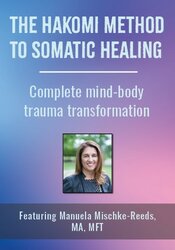
Join somatic healer Manuela Mischke-Reeds to discover the Hakomi Method, one of the most well-established Somatic Psychotherapy approaches to trauma healing in the world.


Manuela Mischke-Reeds, MA, MFT, is a somatic trauma psychotherapist, author, international teacher of somatic psychology, and senior Hakomi trainer. She is the founder of Embodywise, an international learning community offering professional training in trauma therapy, somatic psychology, and the Hakomi Method, and is a co-founder of the Hakomi Institute of California.
She is the developer of the Innate Somatic Intelligence Trauma Therapy Approach (ISITTA), an integrative somatic psychotherapy framework that supports trauma recovery through nervous system regulation, embodied awareness, movement-based integration, and relational therapeutic processes.
With over 30 years of clinical experience, Manuela has taught professional training programs internationally across North America, Europe, Asia, and Australia. In the field of psychedelic therapy, she offers specialized somatic approaches, including somatic therapy techniques, movement-based integration, and ethical touch practices, to support psychedelic-assisted psychotherapy through a trauma-informed, relational lens.
She is the author of several books, including Embodied Psychedelic Therapy: A Somatic Guide (W. W. Norton, with Joshua Sylvae), Somatic Psychotherapy Toolbox (PESI), Trauma-Sensitive Movement (PESI), and 8 Keys to Practicing Mindfulness (W. W. Norton).
She is also a contributing author to Hakomi Mindfulness-Centered Somatic Psychotherapy: A Comprehensive Guide to Theory and Practice (W. W. Norton), The Complete Trauma Treatment Guide (PESI), and The Praeger Handbook of Community Mental Health Practice (Praeger), for which she authored the chapter "The Role of Trauma in Community Health: A Somatic Perspective."
Speaker Disclosures:
Financial: Manuela Mischke-Reeds is the founder of Embodywise and has an employment relationship with Embodylab. She receives compensation as a consultant and royalties as a published author. She receives a speaking honorarium, recording, and book royalties from PESI, Inc. She has no relevant financial relationships with ineligible organizations.
Non-financial: Manuel Mischke-Reeds has no relevant non-financial relationships.


