Picking Apart Pain


“What was that?” I asked.
“Well, you seem like you’re enjoying the experience of suffering, so I thought I’d help you out with that.”
He wisely explained that there’s a difference between pain and suffering. Pain is beyond our control—it’s part of being a person in the world. We’re all going to experience pain at times, but we don’t have to suffer so much. “You’re not choosing the pain, but you’re choosing the suffering,” Wendell said.
He was right. I was creating my own suffering by telling the story of Boyfriend over and over, by Googling him and making up stories about what I’d found—stories that inevitably provided evidence for a bigger story: I wasn’t lovable enough.
Our pain holds important clues about what’s not working in our lives and what we might start to change. Nobody likes to feel it, though, so we push it away any way we can. We gloss over painful feelings or we lash out at others because of it. More often, we turn those feelings inward and berate ourselves. All of this serves to take the pain, which may have been initially helpful, and twist it into something more like suffering.
So how do you shift out of suffering?
Here’s where reading between the lines can help. By examining a few pain points in your stories, you begin to see what that pain is telling you and where you’re creating suffering. Consider this exercise our workbook’s version of Wendell’s kick.

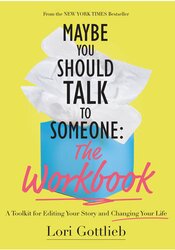
Lori decided to do just that. In this empowering, one-of-a-kind workbook, Lori offers a step-by-step process for becoming the author of your own life by giving it a thorough edit. Using eye-opening concepts, thought-provoking exercises, compelling writing prompts, and real examples from the patients in the original book, Lori has created an easy-to-follow guide through the journey of becoming our own editors, examining aspects of our narratives that hold us back, and discovering the ways in which changing our stories can change our lives.
An experience, a meditation, and a practical toolkit combined into one, Maybe You Should Talk to Someone: The Workbook is the companion readers have been asking for: a revolutionary method for understanding which stories to keep and which to revise so that we can create our own personal masterpieces. By the end of this “unknowing,” you will be surprised, inspired, and most of all, liberated.

Lori Gottlieb, LCSW, is a psychotherapist and New York Times bestselling author of Maybe You Should Talk to Someone, which has sold over one million copies and is currently being adapted as a television series. In addition to her clinical practice, she writes The Atlantic's weekly "Dear Therapists" advice column and is co-host of the popular "Dear Therapists" podcast produced by Katie Couric. She contributes regularly to The New York Times and many other publications, and her recent TED Talk was one of the Top 10 Most Watched of the Year.
A member of the Advisory Council for Bring Change to Mind, she is a sought-after expert in media, such as The Today Show, Good Morning America, CBS This Morning, CNN and NPR's "Fresh Air." Learn more at LoriGottlieb.com or by following her on Twitter @LoriGottlieb1 and Instagram @lorigottlieb_author.
Speaker Disclosures:
Financial: Lori Gottlieb maintains a private practice. She is an author for PESI Publishing and receives royalties.
Non-financial: Lori Gottlieb is a member of the Advisory Council for Bring Change to Mind.


