Turning Hopeless into Hopeful: Using Creative Hopelessness to Help Clients Let Go


If the outcome of their actions is not productive or does not cause growth, there is no use trying the same technique over and over. And still, they do it, expecting a different result than all the times before. The therapist can suggest they stop, but because clients can become so attached to their own ways, the odds of them stopping immediately are relatively slim.
Creative hopelessness, first developed by acceptance and commitment therapy (ACT) founder Steven Hayes and his colleagues, is the process of helping clients let go of what is not working. The expression of hopelessness may sound negative, but if we can evoke feelings of hopelessness in the client about the things that are not working for them, they are more likely to stop engaging in those behaviors. In fact, the point of this process is to help clients feel more hopeful that they can break out of the feeling of being stuck.
You may have clients who are metaphorically banging their heads against the wall. You can calmly say, “Well, maybe you shouldn’t bang your head against the wall.” These clients might then say, “You don’t understand! I’m working so hard trying to break through this wall. I’m really persevering with this! You’re not being helpful by telling me to stop—you’ve got to teach me how to hit it harder!”
Rather than arguing with our clients, we want their own life experiences to inform them. We want them to systematically go through everything they have ever tried to do to get rid of their anxiety and consider how each method has worked for them. Eventually, clients come to realize that their attempts to control or avoid things, especially their own thoughts and feelings, are actually feeding their anxiety, not making it better. Only when they realize that it has not been working will they consider letting go of an old behavior.
I recently had a client, whom I’ll call Mary, who experienced significant anxiety. In the first session, I told her that it would be very important for us not to repeat past mistakes, and that she should not keep doing something if it hasn’t been working. Check out how creative hopelessness changed her mindset:
- Therapist: What are some of the things you’ve tried before when you’re struggling with anxiety?
Mary: Well, I just try to tell myself I’m going to be okay, and that this is temporary, or I just try not to think about the things that worry me.
Therapist: Okay, so you try to use positive self-talk to talk yourself out of the anxious feelings, or you try to ignore the thoughts. How’s that worked for you so far? How effective has it been?
Mary: Well, sometimes it works maybe for a few days, but then I’ll have another thought like "Oh no, what if this anxiety causes a heart problem?! Then that makes me anxious again.
Therapist: It sounds like it works a little bit temporarily. But you also told me you have been struggling with this for years and years, so is it safe to say—and don’t let me put words into your mouth—that talking yourself out of the thoughts or ignoring them has not been the ultimate solution to this problem?
Mary: No, it only works temporarily at best. I just keep thinking that if I try harder and think more positively, it will work.
Therapist: Has trying harder made things better in the long run?
Mary: No. That’s why I’m here.
Therapist: So, thinking does help sometimes, which is why you have been doing it for so long. But do the temporary benefits come with any costs? Have there been any downsides to trying harder to think positive?
Mary: Well, it has cost me a lot in my relationships, because I’m always thinking and worrying, and I’m not very present with people around me. In fact, I took my husband out for his birthday recently. Because our kids are so young, it was the first time in years that we had a date night for just the two of us. Then I had a thought that my heart didn’t feel right, and so I spent the whole dinner worrying about my heart. I kept crying, and my husband was frustrated because he’s so tired of me complaining all the time about my anxiety.
Therapist: Okay, so these attempts to try to talk yourself out of the anxiety have also come with a price. Here’s the thing—in our therapy sessions, we don’t want to do more of something that you are telling me has not worked for you. If you’ve been using a proverbial hammer to deal with your anxious thoughts, you may think that I’m going to give you a sledgehammer to deal with them. And if that was working, I would help you do that. But based on your own experience, it sounds like fighting these thoughts is just not working for you. So, can we agree not to fight the thoughts harder?
Very systematically, the therapist takes account of everything the client has tried so that the client feels motivated to stop doing what isn’t working. In addition to helping them let go, this process is very empathic and validating of their lived experiences.
It is important for clinicians not to keep trying to talk clients out of what they are doing. This is likely to generate resistance and defensiveness. Be patient. After all, you know that what they are doing is not working, or they would not be in your office in the first place. A realization is more powerful when a client can make it themselves.
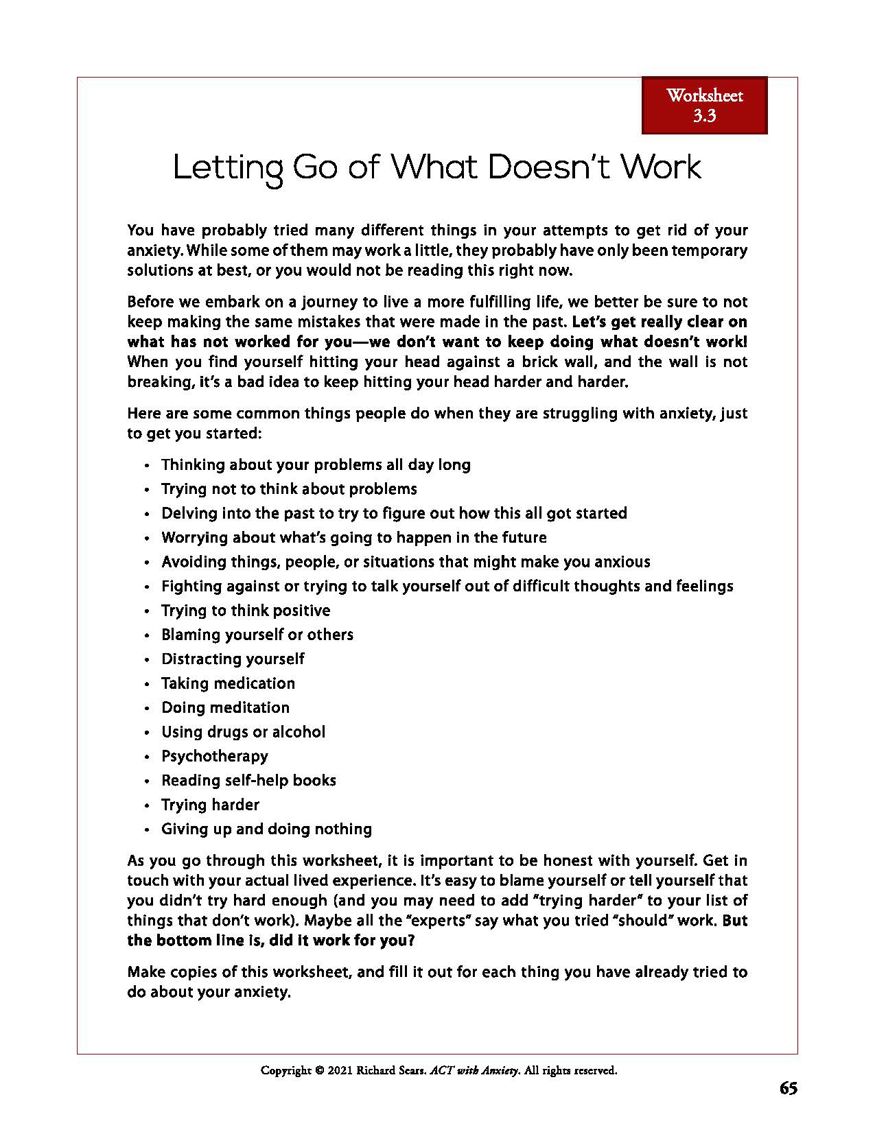
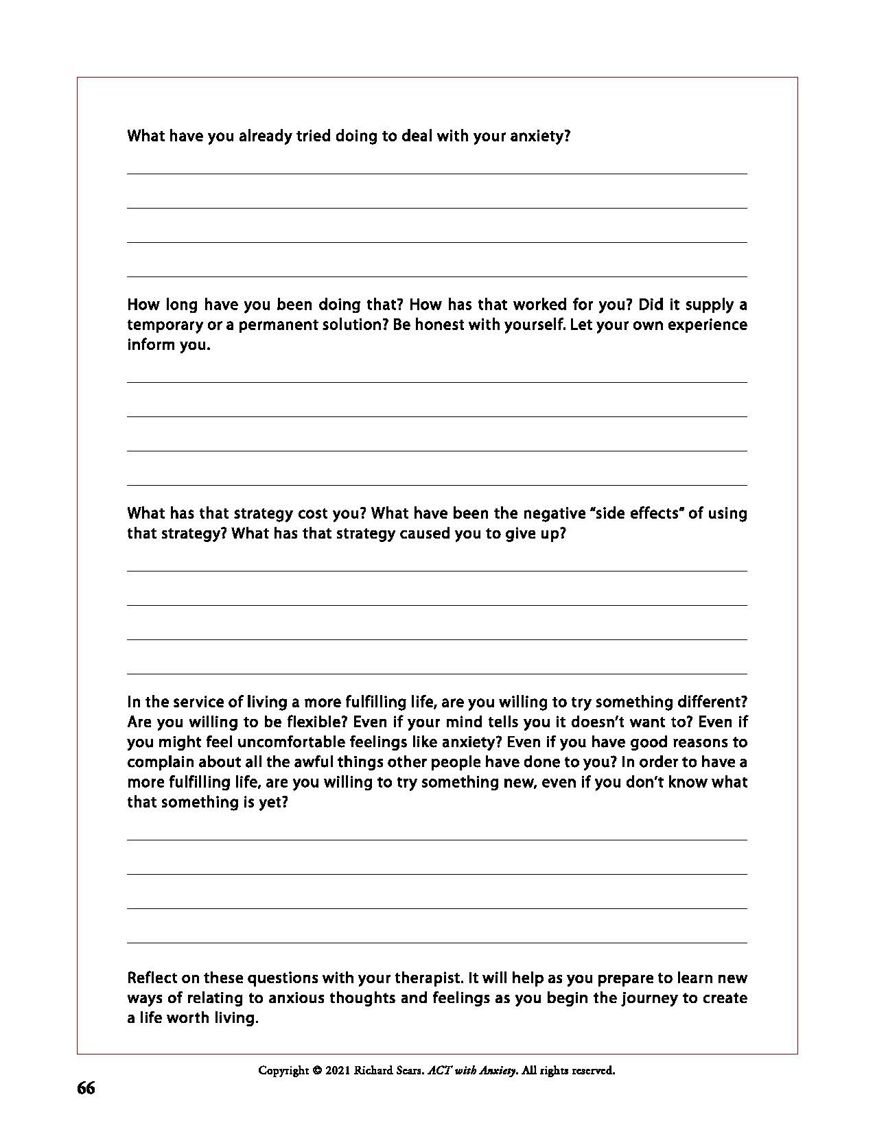
Use this free worksheet to help your clients consider and let go of the things that have not been working in their attempts to control their anxiety.
Want to learn more? Discover the essentials of Acceptance and Commitment Therapy in my blog: Getting Unstuck from Anxiety.

In this engaging and easy-to-read workbook, Dr. Sears provides detailed explanations, case examples, and practical worksheets to show you how to work with your anxiety instead of trying to battle against it. Using cutting-edge techniques and principles, you’ll learn tools to transform anxiety and create a richer and more fulfilling life.

Richard Sears, PsyD, PhD, MBA, ABPP, is a licensed psychologist in Cincinnati, Ohio, board certified in clinical psychology by the American Board of Professional Psychology (ABPP), runs a private psychology and consultation practice, and is the director of the Center for Clinical Mindfulness & Meditation. He has run hundreds of mindfulness groups and was lead clinician in the first brain scan study involving mindfulness with children and adolescents. He is also an adjunct professor in the University of Cincinnati psychology department, clinical research faculty at the UC Center for Integrative Health and Wellness, volunteer professor of psychiatry & behavioral neurosciences at the UC College of Medicine, and a former research/psychologist contractor with the Cincinnati VA Medical Center.
His most recent books include ACT with Anxiety (PESI); The ACT Flip Chart (PESI); Cognitive Behavioral Therapy & Mindfulness Toolbox (PESI); Mindfulness: Living Through Challenges and Enriching Your Life in the Moment (Wiley-Blackwell); Building Competence in Mindfulness-Based Cognitive Therapy (Routledge); and Mindfulness-Based Cognitive Therapy for PTSD (Wiley-Blackwell).
Dr. Sears is a sixth-degree black belt in Ninjutsu, and once served as a personal protection agent for the Dalai Lama with his teacher, Stephen K. Hayes. He has studied Eastern Wisdom for over 40 years, receiving ordination in three traditions, and transmission as a Zen master.
Speaker Disclosures:
Financial: Dr. Richard Sears maintains a private practice and has employment relationships with the University of Cincinnati College of Medicine, the University of Cincinnati for Integrative Health and Wellness, Alliance Integrative Medicine, and Wright State University School of Professional Psychology. He receives compensation as a consultant and royalties as a published author. Dr. Sears receives a speaking honorarium, recording, and book royalties from PESI, Inc. He has no relevant financial relationships with ineligible organizations.
Non-financial: Dr. Richard Sears is a member of the Association for Contextual Behavioral Science, a diplomate of the American board of Professional Psychology, and a fellow with the Academy of the American Board of Clinical Psychology. He is a peer reviewer for Mindfulness and a book reviewer for John Wiley & Sons, Inc, and Routledge. He is the director of Center for Clinical Mindfulness and Meditation.


