
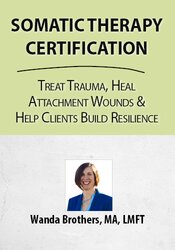
Somatic Therapy Certification
Treat Trauma, Heal Attachment Wounds & Help Clients Build Resilience
- Speaker:
- Wanda Brothers, MA, LMFT
- Duration:
- 18 Hours 49 Minutes
- Format:
- Audio and Video
- Copyright:
-
Jul 22, 2026
- Product Code:
- POS150796
- Media Type:
- Digital Seminar - Also available: In-Person Seminar | Live Webcast

Description
- Learn to do somatic therapy start-to-finish
- Treat attachment wounds, trauma, anxiety & more
- Get easy-to-use techniques you can use forever
Your fastest track to becoming a Certified Somatic Therapy Foundations Practitioner!
You’ll go from knowing about somatic therapy to mastering the core principles, techniques, and applying skills.
In this start-to-finish certification training, you’ll join Wanda Brothers, Somatic Experiencing™ practitioner with more than 23 years of experience in trauma healing and certified in Dynamic Attachment Repair experience (DARe).
Wanda blends her unique expertise in somatic therapy, attachment, complex trauma and more into practical skills you can apply immediately. Plus, this training is deeply experiential!
You’ll discover:
- The neurobiology of how somatic therapy works and how to work with attachment wounds
- The keys to repairing insecure attachment styles with somatic techniques
- Skills for helping clients create boundaries and resilience
- Strategies for working with shame, borderline symptoms, dissociative disorders, chronic pain and more
And so much more!
You’ll walk away from this certification training with the best practices and techniques from somatic therapy …
And, you’ll meet all the educational requirements to become a Certified Somatic Therapy Foundations Practitioner.
Purchase now!
Credit
Speaker

Wanda Brothers, MA, LMFT Related seminars and products
Wanda Brothers, MA, LMFT, is a Somatic Experiencing™ practitioner and certified in Dynamic Attachment Repair experience (DARe), somatic coach, and trauma-healing expert with over 23 years of clinical experience. For the past 18 years, she has specialized in the integration of neuroscience, physiology, and attachment theory to help clients resolve and heal deep-rooted wounds and restore emotional regulation.
In addition to her clinical practice, Wanda is a seasoned speaker, educator, and clinical supervisor and recently accepted the role of Professor of Somatics for the master’s program at Integrative Psychology Institute. A former professor at Point Loma Nazarene University (PLNU) Wanda is known for her ability to translate complex concepts into engaging, accessible language for both professional and public audiences. She regularly provides workshops and trainings on trauma and stress reduction, nervous system regulation, and relational healing for schools, businesses, and community organizations.
Wanda also created the Educational Trauma and Resiliency program, a four-module training designed for teachers in underserved schools, equipping them with practical tools on trauma, attachment, and fostering resiliency in students.
Her teaching is grounded in the understanding that human behavior is not solely a product of the mind but is deeply influenced by the body and automatic physiology. By helping clients and students learn how the autonomic nervous system shapes emotions and behaviors, Wanda empowers them to approach life’s challenges from a more regulated, resilient, and connected state.
Wanda’s work reflects her passion for creating a world with less stress, anger, and anxiety – and more capacity for love, peace and vitality.
Speaker Disclosures:
Financial: Wanda Brothers is the owner of Real Life Solutions- Trauma Recovery and has an employment relationship with Integrative Psychology Institute. She receives a speaking honorarium and recording royalties from PESI, Inc. She has no relevant financial relationships with ineligible organizations.
Non-financial: Wanda Brothers is a member of the California Association of Marriage & Family Therapists.
Additional Info
Questions?Visit our FAQ page at www.pesi.com/faq or contact us at www.pesi.com/info
Access for Self-Study Program (Non-Interactive)
You will have access to this product for 12 months from the date of purchase.
Objectives
- Identify major historical developments that shaped modern somatic psychology.
- Evaluate the convergence of attachment theory and somatic trauma treatment.
- Analyze foundational somatic pacing and safety practices in early sessions
- Utilize somatic interventions for collapsed and rigid boundaries.
- Use a somatic assessment that identifies activation patterns, implicit memory traces, and attachment markers.
- Utilize at least one somatic intervention specific to anxious, avoidant, and disorganized attachment styles.
- Analyze how early relational experiences shape the autonomic nervous system.
- Evaluate the relationship between implicit memory and attachment patterns.
- Identify somatic indicators of shame activation.
- Choose appropriate somatic interventions for disorders commonly associated with attachment trauma.
- Apply therapist somatic awareness to enhance attunement, co-regulation, and mis-attunement repair.
- Analyze ethical considerations unique to somatic work, including consent, boundaries, and scope of practice.
- Use interoceptive awareness to distinguish therapist sensations from client experience.
- Apply somatic boundary interventions to strengthen containment and relational safety.
- Identify somatic indicators of dissociation, fragmentation, and chronic stress physiology.
- Distinguish trauma-related somatic symptoms from medical conditions requiring referral or interdisciplinary care.
- Modify somatic interventions when working with high-risk presentations
- Modify somatic and attachment-based interventions for tele-health delivery, cultural context, and developmental stage.
- Identify therapist somatic responses to prevent boundary drift and attachment pull in clinical work.
Outline
Part 1: Foundations of Somatic Therapy
- History & Origins of Somatic Psychology
- How somatic psychology and attachment theory converge
- Assess your own attachment style
- Sensorimotor techniques
- Somatic Experiencing® principles
- Polyvagal informed somatic regulation
- Micro-tracking interoception and proprioception
- The 4 key boundaries to know
- Developmental origins of collapsed vs rigid boundaries
- Use mirror neurons to understand the client’s experience
- Reframe “difficult” clients
- Build a phased treatment plan
- Notice subtle cues in body language, eye movements and posture
- Map your client’s underlying attachment wiring
- Create corrective emotional experiences
- Risks, limitations and ethical issues
Part 2: Somatic Trauma Core Neurobiology
- Impact of early miss attunement or abuse
- Brain regions and the relationship to attachment styles
- Neurobiology of attachment styles
- Working with implicit memories and brain wiring
- Anxious attachment style: “I’ll never get enough love”
- Help clients transition from anxious toward secure
- Target memory rumination
- Help clients create internal and external boundaries
- Simple exercises to repair the core attachment wound
- Avoidant attachment style: “I am all I need.”
- Support clients to notice and experience goodness
- Target memories that reinforce disconnection & withdrawal
- Effective boundaries for avoidantly attached clients
- Disorganized attachment style: “I need you but relationships are dangerous”
- Enhance relational safety with distance, pacing and more
- Target memories that reinforce dissociation
- Case study “Thea, 35 y/o: C-PTSD, Early developmental Trauma
Part 3: Complex Trauma, Related Disorders, Special
- Key disorders commonly impacted by attachment trauma
- How relational trauma contributes to dissociation and fragmentation
- Chronic stress physiology
- When to work on trauma vs when to stabilize
- Cultural and developmental considerations
- Working with high levels of dissociation or fragmentation
- Touch and other consideration for body-based work
- Working with survivors of torture, physical, or sexual abuse
- Telehealth considerations
- Strategies for relapse prevention
- Case study “Judy, 55 y/o: Attachment trauma, PTSD, major depressive disorder”
- Self-of-the therapist work
- Avoid getting “pulled in”
- Identify your own implicit memories
- Transference and countertransference
- Documentation, consent and ongoing permission
- Power dynamics and vulnerability
- Inclusion and bias awareness
Target Audience
- Counselors
- Social Workers
- Psychologists
- Psychotherapists
- Therapists
- Marriage & Family Therapists
- Addiction Counselors
- Case managers
- Physicians
- Nurses
- Other Mental Health Professionals



Reviews
Satisfaction Guarantee
Your satisfaction is our goal and our guarantee. Concerns should be addressed to: PO Box 1000, Eau Claire, WI 54702-1000 or call 1-800-844-8260.
ADA Needs
We would be happy to accommodate your ADA needs; please call our Customer Service Department for more information at 1-800-844-8260.
PESI Mobile App
Access CE trainings on your phone or tablet through our free mobile app. Choose video or audio-only versions of online courses from the world’s best instructors, and complete your CE requirements anywhere, anytime, at your own pace.




Please wait ...