


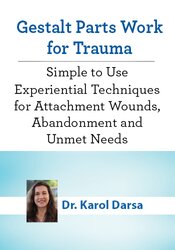
Gestalt Parts Work for Trauma
Simple to Use Experiential Techniques for Attachment Wounds, Abandonment and Unmet Needs
- Speaker:
- Karol Darsa, PsyD
- Duration:
- Approx 6 hours
- Copyright:
-
Jun 15, 2026
- Product Code:
- POS150702
- Media Type:
- Digital Seminar - Also available: Live Webinar

Description
Get Easy-to-Use Tools to Work With Your Clients Inner Child, Inner Critic, Protectors and More!
- Step-by-step instruction so you know what to do
- Tools to make peace with painful memories and unresolved experiences
- Demonstrations that make application simple
- Ready to use scripts for sessions
“I couldn’t believe an intervention this simple was creating these kinds of results …”
The wounded child. The harsh inner critic. The protector. Your client needed all these parts to survive their childhood trauma.
And now that they’re in your care, you need tools to reach their fragmented inner world to help them heal.
Gestalt therapy gives you those tools.
Simple, experiential techniques and role plays – many that only take a few minutes – proven to help clients experience emotional breakthroughs.
You’ll learn the very best Gestalt has to offer so you can lower your clients’ defenses, increase their self-compassion and help them embody their inner parts in transformative healing experiences.
Here’s what you’ll walk away with:
- Step-by-step protocols for facilitating powerful dialogues between wounded parts, protector parts and critical voices
- Live demonstrations showing you precisely how to guide clients from setup to breakthrough moments
- Ready-to-use scripts and language
- Real case examples showing you how to navigate resistance, flooding and other tricky moments
This technique integrates with almost any approach. You don’t need theatrical skills, or a big dramatic setup.
And if you’re worried this type of work will feel too awkward for you or your clients, don’t be. So many clients say this was the most powerful part of therapy for them …
These are some of the most practical, repeatable, and therapist-friendly experiential tools you can add to your clinical toolbox.
Purchase now!
Credit
Speaker

Karol Darsa, PsyD Related seminars and products
Karol Darsa, PsyD, is an accomplished trauma psychologist with over 25 years of experience who has been featured as a key expert on Katie Couric’s nationally syndicated program, The Doctors, ABC, CBS, Well + Good, and other media outlets and podcasts.
The author of The Trauma Map: Five Steps to Reconnect with Yourself and The Trauma Bridge: Reconnecting Body and Mind for Clinicians and their Clients, Dr. Darsa is also the founder of the Reconnect Trauma Center and creator of the Reconnect Integrative Trauma Treatment Model (RITTM).
Dr. Darsa lectures about trauma treatment at several universities, including the University of Southern California, UCLA, and Cal Lutheran and has presented at various conferences including the Global Exchange Conference. She also co-created The Invisible War Recovery Program, an intensive trauma treatment program for veterans suffering from military sexual trauma, inspired by the Academy-Award nominated documentary The Invisible War.
Speaker Disclosures:
Financial: Karol Darsa maintains a private practice and is the founder of Reconnect Integrative Trauma Treatment Center. She receives royalties as a published author. Karol Darsa receives a speaking honorarium from PESI, Inc. She has no relevant financial relationships with ineligible organizations.
Non-financial: Karol Darsa has no relevant non-financial relationships.
Additional Info
Access for Self-Study (Non-Interactive)Access never expires for this product.
Questions?
Visit our FAQ page at www.pesi.com/faq or contact us at www.pesi.com/info
Objectives
- Identify the clinical features of relational trauma.
- Examine the relationship between body awareness and emotion regulation.
- Utilize Gestalt chair dialogues between vulnerable child parts, disowned parts, and internalized critical parent voice.
- Choose chair work variations (e.g., child vs. critical parent, conflicted parts) to help clients reduce shame and self-criticism.
- Utilize chair dialogues to help clients process abandonment wounds, unmet needs, and critical introjects.
- Integrate chair work as a clinical tool to strengthen therapeutic presence and resilience.
Outline
Foundations of Relational Trauma & Safety
- Relational trauma and its impact on self-concept and relationships
- Historical roots: Gestalt, art therapy, and parts work approaches
- Why experiential interventions are effective for unresolved relational wounds
- Principles of safety: resourcing, containment, and pacing to avoid re-traumatization
- Clinical cautions and contraindications
Somatic Awareness & Grounding Techniques
- The role of the body in Gestalt chair work and trauma resolution
- Teach clients to track somatic cues (breath, tension, posture, movement) during dialogues
- Integrate grounding and resourcing before and after emotional activation
- Demo: Therapist using somatic tracking to regulate affect during chair dialogue
- Case vignette: use body awareness to prevent emotional flooding and promote integration
- Research, risks and limitations
Gestalt Empty Chair: The Basics
- Theory and rationale for chair work in trauma treatment
- Step-by-step structure of the technique
- Sample therapist scripts and framing language
- Demo: therapist guiding client into dialogue with a vulnerable part
- Analysis and clinical takeaways
- Research, risks and limitations
Gestalt Empty Chair: Variations & Adaptations
- Apply chair work with critical parent voices, protector parts, or other disowned parts
- Integrate somatic awareness in chair dialogues
- Demo: Critical parent vs. child dialogue
- Case vignette illustration
- Troubleshoot: manage dissociation, resistance, or emotional flooding
Repair the Relational Template
- Use chair work and writing to address
- Abandonment wounds and unmet needs
- Critical/neglectful parent introjects
- Reclaim voice, creativity, and play
- Case vignette: healing dialogue with a punitive parent voice
- Scripted closure: help clients reparent and integrate safely
Explore the Clinician’s Own Parts
- Why therapists benefit from exploring their own wounded and protector parts
- Reflection prompts for journaling and non-dominant writing
- Strengthen therapeutic presence through personal experiential work
- Ethics and boundaries when introducing inner child/parts work with clients
Target Audience
- Counselors
- Social Workers
- Marriage & Family Therapists
- Psychologists
- Psychiatrists
- Case Managers
- Addiction Counselors
- Registered Therapists
- Psych Nurses
- Other Mental Health Professionals



Reviews
Satisfaction Guarantee
Your satisfaction is our goal and our guarantee. Concerns should be addressed to: PO Box 1000, Eau Claire, WI 54702-1000 or call 1-800-844-8260.
ADA Needs
We would be happy to accommodate your ADA needs; please call our Customer Service Department for more information at 1-800-844-8260.
PESI Mobile App
Access CE trainings on your phone or tablet through our free mobile app. Choose video or audio-only versions of online courses from the world’s best instructors, and complete your CE requirements anywhere, anytime, at your own pace.




Please wait ...