
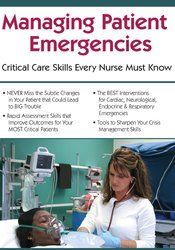
Managing Patient Emergencies
Critical Care Skills Every Nurse Must Know
- Speaker:
- Robin Gilbert, MSN, RN, CEN, CPEN
- Duration:
- 6 Hours 19 Minutes
- Format:
- Audio and Video
- Copyright:
-
Sep 19, 2019
- Product Code:
- POS076005
- Media Type:
- Digital Seminar

Description
Mrs. Kelp is admitted with pneumonia and right-sided heart failure.Twenty minutes after admission, she develops worsening dyspnea and hypotension.
- Are you prepared to manage her unstable condition?
- Do you know what respiratory measures are necessary?
- Do you know the best way to manage her hypotension?
The patients in our hospitals are sicker than ever before. It is not uncommon to find patients on regular medical floors with central lines, chest tubes, pacemakers and AICDs.
Some nursing homes are accepting patients on ventilators, and patients are now being sent home on vasoactive drips such as dobutamine. Even though acuity levels are higher you are still caring for many patients and don’t have the luxury of frequent, comprehensive assessments.
Therefore, it is important to be able to rapidly assess and implement appropriate interventions.
Watch this recording to sharpen your skills and leave prepared to identify and manage your next patient emergency.
Credit
Speaker

Robin Gilbert, MSN, RN, CEN, CPEN Related seminars and products
Robin Gilbert, MSN, RN, CEN, CPEN, has over 25 years’ experience in emergency nursing. She is both a certified emergency nurse and certified pediatric emergency nurse. Robin has experience as an emergency department manager, manager of cardiac & pulmonary rehabilitation and currently as the regional manager for staff development at Central Main Medical Center. She instructs the NCLEX review class for Kaplan and tutors nursing students online for a local college of nursing. Her experience also includes having been an item writer for the Board Certification of Emergency Nursing and a former chairperson. In her current role, Robin is able to remain up to date in the trends and best practice standards for care in emergency nursing. Robin received her BSN from Curry College, Massachusetts and her MSN from Saint Joseph’s College, Maine. Robin is an active member of the Emergency Nurses Association, the American Nurses Association, Society of Critical Care Medicine, and is a reviewer for the ANCC’s Pathway to Excellence.
Speaker Disclosures:
Financial: Robin Gilbert has employment relationships with EBSCO, Rumford Hospital, Pathway to Excellence, and Kaplan University. She receives a speaking honorarium and recording royalties from PESI, Inc. She has no relevant financial relationships with ineligible organizations.
Non-financial: Robin Gilbert is a member of the Emergency Nurses Association.
Additional Info
Access for Self-Study (Non-Interactive)Access never expires for this product.
Questions?
Visit our FAQ page at www.pesi.com/faq or contact us at www.pesi.com/info
Objectives
- Distinguish two types of rapid assessment techniques and how to employ them for the best results during a patient emergency.
- Evaluate techniques for getting critical information during a rapid patient assessment.
- Investigate EARLY assessment findings in clinical syndromes that may progress rapidly and cause life-threatening conditions.
- Prioritize nursing actions for specific neurological, cardiac, respiratory and endocrine emergencies.
- Assess care of the diabetic patient in diabetic ketoacidosis.
- Determine patient populations who are at high-risk for bedside emergencies.
- Propose how to integrate assessment data and critical lab findings into the plan of care for a patient experiencing a life-threatening emergency.
Outline
Identifying the RED Flags
- Critical Thinking During a Crisis
- Vital Signs & ABCDs
- Methods for Establishing and Maintaining Airway
- Breathing: More Than a Rate Issue Circulation & Perfusion
- Rapid Assessment Techniques
- Critical Questions to Ask Your Patient
- Identifying High-Risk Populations
- Sick or Not Sick…Who would you see first?
Cardiovascular Prevention, Presentation, Action for: “I’m having chest pain”
- Recognizing Arrhythmias - Stable, Unstable and Lethal
- Rhythm Recognition & Treatment for: VT, VF, SVT, and Heart Blocks
- Acute Myocardial Infarction: STEMI/ NSTEMI
- Key Assessments & Interventions tPA Guidelines
- Laboratory Parameters
- Recognizing Subtle Changes
- Hemodynamic Monitoring:
- MAP, CO, SV, CI
- Preload, Afterload, Contractility
- Skills Practice: EKG Interpretation
Respiratory Prevention, Presentation, Action for: “I can’t breathe”
- Capnography Basics
- Assessment & Critical Interventions for:
- Pulmonary Embolism
- Respiratory Failure
- COPD
- ARDS
- The Patient Who Needs Assistance
- O2, CPAP, BiPAP
- Indications for Intubation
- Positive Pressure Ventilation
- Chest Tube Management
- Easy ABG Analysis…Really!
Endocrine Prevention, Presentation, Action for: “I don’t feel right”
- The Differences of DKA and HHNK
- Early Recognition of Hypoglycemia
- Critical Lab Findings
- Differentiating the Diagnosis – Case Studies
- Which Intervention Should you do FIRST
- What is the Likely Problem
- Anticipating the Solutions
Neurological Prevention, Presentation and Action for: “My head hurts!”
- Elevated Intracranial Pressure
- Clues When you Don’t have a Monitor
- Ischemic vs. Hemorrhagic Stroke
- Inclusion/Exclusion for tPA
- Critical Labs
- Malignant Headache
- Delirium
- Autonomic Dysreflexia
- Simulation Lab Review
- Interpreting the Patient’s Presentation
Fluid Imbalance/Circulatory Emergencies
- Sepsis
- Shock
- GI Bleed
- Abdominal Aortic Aneurysm
- Compartment Syndrome
Managing the Decompensating Patient
- No Pulse, No Blood Pressure, No Respirations...Now What?
- Common Medications
- Monitor/Defibrillator Review
- Roles & Responsibilities During a Code
What’s New & Trending
- Ethical Considerations
- Documentation Pitfalls
- Staffing Considerations & High Acuity Patients
Target Audience
- Nurses
- Nurse Practitioners
- Clinical Nurse Specialists
Reviews
| 5 |
|
| 4 |
|
| 3 |
|
| 2 |
|
| 1 |
|
Overall: 5
Total Reviews: 3
Satisfaction Guarantee
Your satisfaction is our goal and our guarantee. Concerns should be addressed to: PO Box 1000, Eau Claire, WI 54702-1000 or call 1-800-844-8260.
ADA Needs
We would be happy to accommodate your ADA needs; please call our Customer Service Department for more information at 1-800-844-8260.
PESI Mobile App
Access CE trainings on your phone or tablet through our free mobile app. Choose video or audio-only versions of online courses from the world’s best instructors, and complete your CE requirements anywhere, anytime, at your own pace.




Please wait ...