
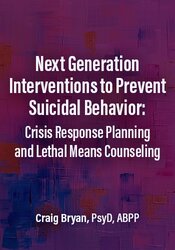
Next Generation Interventions to Prevent Suicidal Behavior
Crisis Response Planning and Lethal Means Counseling
- Speaker:
- Craig J. Bryan, PsyD, ABPP
- Duration:
- 1 Hour 06 Minutes
- Format:
- Audio and Video
- Copyright:
-
Aug 17, 2026
- Product Code:
- POS150889
- Media Type:
- Digital Seminar

Description
When a client is in an acute crisis, a survival-focused approach can save lives.
But an overreliance on survival-focused strategies with clients who struggle with chronic suicidality can unintentionally keep treatment reactive...
...rather than preventing future episodes of increased risk that can wear away at clients’ resilience.
In this session, Dr. Craig Bryan, renowned developer of the Crisis Response Planning intervention, will teach you how to help your clients recognize early warning signs and take action before suicidal thoughts escalate. You’ll learn:
- A clear framework for intervention with clients who have cycled in and out of suicidal crises
- How and when to best utilize coping strategies to improve clinical outcomes
- Strategies to help clients who feel out of control regain a sense of empowerment
Credit
Speaker
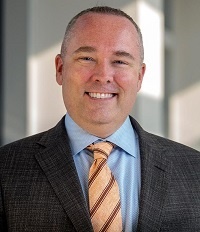
Craig J. Bryan, PsyD, ABPP Related seminars and products
Craig J. Bryan, PsyD, ABPP, is a board-certified clinical psychologist in cognitive behavioral psychology. He is the Stress, Trauma, and Resilience (STAR) Professor of Psychiatry and Behavioral Health at The Ohio State University Wexner Medical Center and is the division director for recovery and resilience. Dr. Bryan received his PsyD in clinical psychology in 2006 from Baylor University and completed his clinical psychology residency at the Wilford Hall Medical Center, Lackland Air Force Base, TX. Dr. Bryan deployed to Iraq in 2009, where he served as the Director of the Traumatic Brain Injury Clinic at the Air Force Theater Hospital. He separated from active-duty service shortly after his deployment, and started researching PTSD, suicidal behaviors and suicide prevention strategies, and psychological health and resiliency. He has held faculty appointments at the University of Texas Health San Antonio, the University of Utah, and The Ohio State University College of Medicine, and has managed numerous federally funded projects in excess of $30 million focused on testing treatments for reducing suicidal behaviors, developing innovative methods to identify and detect high-risk individuals, and facilitating recovery after trauma. Dr. Bryan has published hundreds of peer-reviewed scientific articles and his research has been funded by a wide range of agencies including the Department of Defense, the National Institutes of Health, the Boeing Company, the Bob Woodruff Foundation, and the Navy SEAL Foundation, and has been featured in media outlets including Scientific American, CNN, Fox News, NPR, USA Today, the LA Times, the New York Times and the Washington Post. Dr. Bryan has published over 250 scientific articles and multiple books including Brief Cognitive Behavioral Therapy for Suicide Prevention and Rethinking Suicide.
Dr. Bryan has served as the lead risk management consultant for the $25 million STRONG STAR Research Consortium and the $45 million Consortium to Alleviate PTSD, which investigates treatments for combat-related PTSD among military personnel. Dr. Bryan has served on the Board of Directors of the American Association for Suicidology, the Scientific Advisory Board for the Navy SEAL Foundation, the Educational Advisory Board of the National Center for PTSD, and as a member of the Department of Defense Suicide Prevention and Response Independent Review Committee (SPRIRC). For his contributions to mental health and suicide prevention, Dr. Bryan has received numerous awards and recognitions including the Arthur W. Melton Award for Early Career Achievement, the Peter J.N. Linnerooth National Service Award, and the Charles S. Gersoni Military Psychology Award from the American Psychological Association, and the Edwin S. Shneidman Award for outstanding contributions to research in suicide from the American Association of Suicidology. He is an internationally recognized expert on suicide prevention, trauma, and resilience.
Speaker Disclosures:
Financial: Dr. Craig Bryan has employment relationships with the University of Vermont and Canandaigua VA Medical Center. He receives royalties as a published author. Dr. Bryan receives contracts from the National Institute of Mental Health and the Department of Defense. He is a consultant/trainer for Federal Bureau of Prisons and a consultant for Strong Star Research Consortium and Substance Abuse and Mental Health Services Administration National Advisory Council. Dr. Bryan receives a speaking honorarium and recording royalties from Psychotherapy Networker and PESI, Inc. He has no relevant financial relationships with ineligible organizations.
Non-financial: Dr. Craig Bryan is a member of the American Association for Suicidology, the American Psychological Association, the Association for Behavioral and Cognitive Therapies, Utah Psychological Association, and the International Association for Suicide Prevention. He is an ad hoc reviewer and editor for several peer review journals, for a complete list contact PESI, Inc.
Additional Info
Access for Self-Study (Non-Interactive)Access never expires for this product.
Questions?
Visit our FAQ page at www.pesi.com/faq or contact us at www.pesi.com/info
Access for Self-Study Program (Non-Interactive)
This product includes 12 months of access.
For a more detailed outline that includes times or durations of time, if needed, please contact cepesi@pesi.com.
Objectives
- Identify mechanisms of action underlying the effects of suicide-focused treatments
- Summarize research findings specific to crisis response planning and lethal means counseling
- Differentiate prevention-focused and survival-focused approaches
Outline
Complementary Approaches to Reduce Suicidality
- Why and how suicide-focused interventions work
- Limitations of the research and potential risks
Crisis Response Planning (CRP)
- Focus on preventing suicidal crises and attempts
- Theoretical and conceptual perspectives
- Empirical support for CRP
- Video vignette
Lethal Means Counseling (LMC)
- Background and foundational principles
- Client-centered interventions to reduce risk
- Evidence from clinical trials and mechanisms-focused research
- Video vignette
Target Audience
- Counselors
- Social Workers
- Marriage & Family Therapists
- Psychologists
- Psychiatrists
- Psychotherapists
- Other Mental Health Professionals



Reviews
Satisfaction Guarantee
Your satisfaction is our goal and our guarantee. Concerns should be addressed to: PO Box 1000, Eau Claire, WI 54702-1000 or call 1-800-844-8260.
ADA Needs
We would be happy to accommodate your ADA needs; please call our Customer Service Department for more information at 1-800-844-8260.
PESI Mobile App
Access CE trainings on your phone or tablet through our free mobile app. Choose video or audio-only versions of online courses from the world’s best instructors, and complete your CE requirements anywhere, anytime, at your own pace.




Please wait ...