
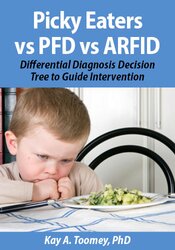
Picky Eaters vs PFD vs ARFID
Differential Diagnosis Decision Tree to Guide Intervention
- Speaker:
- Kay A. Toomey, PhD
- Duration:
- 2 Hours 01 Minutes
- Format:
- Audio and Video
- Copyright:
-
Sep 16, 2021
- Product Code:
- POS064980
- Media Type:
- Digital Seminar

Tags: Rehab Summit
Description
When children don’t eat well, there can be multiple adverse consequences on a child’s health and development.
However, it can be challenging as a clinician to determine which children are the ones most likely to suffer the negative impacts from picky eating. This session will use the most current research to operationally define who is a Picky Eater versus a child who may have an actual Feeding or Eating Disorder.
Dr. Kay Toomey, pediatric expert in eating and feeding, reviews the diagnostic criteria for Pediatric Feeding Disorder (PFD) and Avoidant Restrictive Food Intake Disorder (ARFID), and then shares her Differential Diagnosis Decision Tree to give practitioners clear guidelines for intervention. The Decision Tree will be applied to case studies to practice accurate diagnosis with global recommendations offered for differential treatment as based on each type of diagnosis.
Don’t miss this opportunity to increase your confidence and ability in accurately diagnosing picky eaters, children with a PFD or those with ARFID.
Credit
Speaker

Kay A. Toomey, PhD Related seminars and products
Toomey & Associates, Inc.
Dr. Kay A. Toomey is a pediatric psychologist who has worked with picky eaters and problem feeders for over 35 years. She has developed the SOS Approach to Feeding as a family-centered program for assessing and treating children with feeding problems. Dr. Toomey helped to form The Children’s Hospital – Denver’s Pediatric Oral Feeding Clinic, as well as the Rose Medical Center’s Pediatric Feeding Center.
Speaker Disclosures:
Financial: Kay Toomey is the President of Toomey & Associates and a researcher with the Sensory Processing Disorders Foundation. She receives a speaking honorarium, recording, and book royalties from PESI, Inc. She has no relevant financial relationships with ineligible organizations.
Non-financial: Kay Toomey has a professional relationship with Feeding Matters and The Feeding Trust.
Additional Info
Access for Self-Study (Non-Interactive)Access never expires for this product.
Questions?
Visit our FAQ page at www.pesi.com/faq or contact us at www.pesi.com/info
Objectives
- Differentiate the characteristics of a “picky eater” from either Pediatric Feeding Disorder (PFD) or Avoidant/Restrictive Food Intake Disorder (ARFID).
- Evaluate the validity of the criteria for ARFID.
- Determine critical components of a Differential Diagnosis Decision Tree for Picky Eaters vs PFD vs ARFID.
- Characterize which case study children meet the criteria for which diagnosis.
- Discriminate appropriate treatment approach based on accurate differential diagnosis.
Outline
- Prevalence Data – Summary
- Picky Eaters
- Prevalence
- Definition
- Problem Feeders/PFD
- Prevalence
- Definitions
- ARFID
- History
- Definition
- Validity Problems
- Subgroups
- Prevalence
- Decision Tree Components
- Applying the Decision Tree to Case Studies
- Picky Eater
- PFD
- ARFID
- Feeding Treatment
- Main Approaches
- Recommendations per Diagnosis
Target Audience
- Physical Therapists
- Physical Therapy Assistants
- Occupational Therapists
- Occupational Therapy Assistants
- Speech-Language Pathologists
- Chiropractors
Reviews
Satisfaction Guarantee
Your satisfaction is our goal and our guarantee. Concerns should be addressed to: PO Box 1000, Eau Claire, WI 54702-1000 or call 1-800-844-8260.
ADA Needs
We would be happy to accommodate your ADA needs; please call our Customer Service Department for more information at 1-800-844-8260.
PESI Mobile App
Access CE trainings on your phone or tablet through our free mobile app. Choose video or audio-only versions of online courses from the world’s best instructors, and complete your CE requirements anywhere, anytime, at your own pace.




Please wait ...