


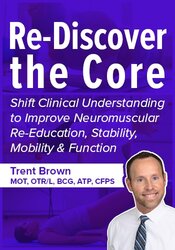
Re-Discover the Core: Shift Clinical Understanding to Improve Neuromuscular Re-Education, Stability, Mobility & Function
- Speaker:
- Trent Brown, MOT, OTR/L, BCG, ATP, CFPS, CGS
- Duration:
- 5 Hours 49 Minutes
- Format:
- Audio and Video
- Copyright:
-
Apr 11, 2025
- Product Code:
- POS065161
- Media Type:
- Digital Seminar

Description
Core function is the apex of all functional movement, yet the “core” is one of the most misunderstood terms in therapy, medicine, and athletics.
With this robust approach that is centered on functional stability and mobility, you’ll re-define the “core” and explore a powerful new array of clinical tools that accelerate outcomes.
Filled with techniques for transverse, sagittal, and frontal planes, these evidence-based strategies apply to patients of all ages and abilities. As you highlight neuro-muscular re-education, you’ll learn how to:
- Utilize the optimal contraction sequence for functional activities in supine, seated and standing
- Integrate standardized assessments that address core weakness and dysfunctional movement patterns
- Expertly transition from assessment to treatment
- Create activities and exercises for patients of all abilities
- Maximize reimbursement with best practices for billing and documentation
Through a series of interactive labs, this comprehensive training will ensure mastery and confidence to implement these concepts into your practice the very next day. With broad applications from sit to stand, bed mobility, fall risk reduction and improvement of low back pain, to accelerating outcomes of elite athletes – you cannot miss this powerful training!
Credit
Speaker

Trent Brown, MOT, OTR/L, BCG, ATP, CFPS, CGS Related seminars and products
Advanced Healthcare
Additional Info
Access for Self-Study (Non-Interactive)Access never expires for this product.
Questions?
Visit our FAQ page at www.pesi.com/faq or contact us at www.pesi.com/info
Objectives
- Investigate missing components of broadly used definitions of the core and how this leads to clinical misunderstanding and lack of evidence when treating core dysfunction.
- Evaluate the core with a functional emphasis using transverse, sagittal, and frontal planes with stability, mobility, and functional emphasis.
- Demonstrate the evolution of contraction for stabilization of the core and spine.
- Appraise standardized evaluations used to evaluate core weakness and stability.
- Distinguish evidence-based core activities and exercises emphasizing the re defined core that promote stability and mobility in supine, seated, and standing.
- Demonstrate dynamic core activities during labs to develop an evolutionary plan of care and to promote functional outcomes.
Outline
Overview of the Core- Evidence of function and clinical significance
- Definitions and myths
- Region: Superior, inferior, central
- Anatomy & physiology of stabilizers vs. mobilizers
- I-IIA-IIX-IIB – muscle contraction slow twitch to fast twitch
- Stability vs. mobility of the brain in the geriatric client
- Contract-Relax-Antagonist-Contract principle (CRAC)
- Sherrington’s Law: Are we emphasizing poor patterns during treatment?
- Trunk Impairment Scale (TIS): core stability and mobility control
- Bent Knee Fall Out (BKFO)
- Side lying SLR
- 3-Plane Core Test
- Supine core stability
- Abdominal Ball Press Lab Demonstration:
- Anterior abdominal wall re-education
- Application: low back pain
- Trochanter Tension Demonstration:
- Supine techniques to contract gluteus medius/minimums, TFL, and QL
- Application: single leg standing balance for mobility and transfers
- Seated core stability
- Dolphin Demonstration:
- Core dissemination during frontal plane mobility
- Application: lateral mobility: bed mobility, toileting, functional reach
- Stable Ball Drop Demonstration:
- Stabilizing the anterior and posterior abdominal walls
- Application: low back pain and fall risk
- Standing core stability
- Wall Plank Demonstration:
- Application: low back pain, LOB, fall risk
- PNF Chop Demonstration:
- PNF functional reaching diagonal patterns
- Application: high to low reaching during functional tasks
- Supine core mobility
- ASIS Press, Scapular Elevation Demonstration:
- Mobilization of the pelvis to reduce soft tissue tightness
- Application: sagittal plan movement of the upper body over the core
- Seated core mobility
- Quad Sit-up Demonstration:
- Sit-stand utilizing lower extremity emphasis
- Application: low back pain, sit-stand/transfers
- Mobile Drop Demonstration:
- Core rotation and reaching in all planes with various weighted objects
- Application: functional reach for ADL’s
- Standing core mobility
- Standing ASIS, Dynamic Chop Demonstration:
- Tactile cues for pelvic extension during sit-stand
- Application: COG over BOS during upright tasks with reduced energy expenditure
Target Audience
- Physical Therapists
- Physical Therapist Assistants
- Occupational Therapists
- Occupational Therapy Assistants
- Chiropractors
- Athletic Trainers
- Massage Therapists
- Other Rehab Professionals
Reviews
Satisfaction Guarantee
Your satisfaction is our goal and our guarantee. Concerns should be addressed to: PO Box 1000, Eau Claire, WI 54702-1000 or call 1-800-844-8260.
ADA Needs
We would be happy to accommodate your ADA needs; please call our Customer Service Department for more information at 1-800-844-8260.
PESI Mobile App
Access CE trainings on your phone or tablet through our free mobile app. Choose video or audio-only versions of online courses from the world’s best instructors, and complete your CE requirements anywhere, anytime, at your own pace.




Please wait ...