
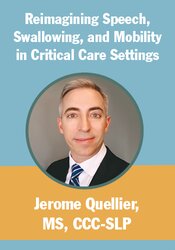
Reimagining Speech, Swallowing, and Mobility in Critical Care Settings
- Speaker:
- Jerome Quellier, MS, CCC-SLP
- Duration:
- 2 Hours 01 Minutes
- Format:
- Audio and Video
- Copyright:
-
Jul 19, 2023
- Product Code:
- POS065338
- Media Type:
- Digital Seminar

Description
Covid presented clear examples of the complications in caring for ventilator supported patients. Acute Care and ICU settings are continually challenged to expedite the stabilization and rehabilitation progression of critically ill patients with acute and chronic tracheostomy/ventilator dependence.
As medical care becomes progressively sophisticated, so should our rehab approach. Join this course and rapidly familiarize yourself with evidence-based diagnostics and rehab interventions surrounding … the restoration of communication and treating related dysphagia following tracheotomization, defining the foundation of establishing an early mobility program, and understanding key factors for the entire team to successfully progress towards extubation/decannulation.
Learn cutting edge skills the entire medical team can utilize to advance rehab outcomes with this complex patient population.
Credit
Speaker

Jerome Quellier, MS, CCC-SLP Related seminars and products
Mr. Quellier is a retired clinical specialist in traumatic brain injury and communication disorders from a 450+ bed level 1 trauma hospital in Saint Paul, MN with over 28 years of acute, residential, and outpatient rehabilitation experience. Throughout his career, he focused on neuro-based diagnostics and intervention for dysphagia, cognitive-linguistic deficits, head and neck cancer management, patient advocacy, and curriculum development. Mr. Quellier completed advanced training in brain dissection at Marquette University, actively engaged in curriculum creation and staff development training, and collaborated with a neurosurgery team in preserving language function during tumor resections.
Mr. Quellier is excited to bring this topic to the forefront after working with the interdisciplinary team’s challenges in understanding the “what and why” of aberrant cognitive control that places patients at heighten dysphagia risk.
Speaker Disclosures:
Financial: Jerome Quellier receives a speaking honorarium and recording royalties from PESI, Inc. He has no relevant financial relationships with ineligible organizations.
Non-financial: Jerome Quellier is a member of the American Speech-Language and Hearing Association.
Additional Info
Questions?Visit our FAQ page at www.pesi.com/faq or contact us at www.pesi.com/info
Access for Self-Study Program (Non-Interactive)
You will have access to this product for 12 months from the date of purchase.
Objectives
- Outline steps to assess both vent and nonvent dependent patients for speaking valve utilization.
- Distinguish three mechanical vent settings for which a speaking valve can be safely used in the tracheotomized patient while recognizing contraindications for placement.
- Prepare/Establish the foundation for early mobilization with vented patients including therapy roles, team responsibilities, and rehab strategies for maximizing both patient safety/cotreating opportunities.
Outline
Mechanical ventilation and the application of speaking values- Physiology of utilization, anatomical review
- Population and timing
- Warning and Precautions
- Assessment and placement on vented and non-vented patients
- Special considerations when placing valve
- Timing/populations valves are utilized
- Trouble shooting difficult placement
- Effect of extubation and tracheostomy upon swallowing physiology
- Determining options for informal vs formal assessments of the tracheotomized patient
- Rehabilitative effect of speaking valve upon swallowing
- Physical inactivity and mechanical ventilation induced weakness on musculoskeletal function
- ADL performance
- Cognition and motor skills, strength
- Early mobility indications/contraindications to safe patient mobilization
- >ul>
- Vital considerations and vent parameters
- Techniques to assist with therapy-induced changes in blood flow
- Strategies to gain confidence mobilizing vent/trach dependent patients
- Implementing early mobilization protocols
- Education on properly setting up trach/vent in preparation for early mobility session
- Proper Management of speaking valve/trach during mobility
- Responding to adverse symptoms
- Shared outcomes of early mobility programming as a team focus
- OT/PT facilitation of SLP goals
- Recognizing opportunities for co treatments
Target Audience
- Registered Nurses
- Nurse Practitioners
- Physician Assistants
- Physical Therapists
- Physical Therapist Assistants
- Occupational Therapists
- Occupational Therapist Assistants
- Speech Language Pathologists
Reviews
Satisfaction Guarantee
Your satisfaction is our goal and our guarantee. Concerns should be addressed to: PO Box 1000, Eau Claire, WI 54702-1000 or call 1-800-844-8260.
ADA Needs
We would be happy to accommodate your ADA needs; please call our Customer Service Department for more information at 1-800-844-8260.
PESI Mobile App
Access CE trainings on your phone or tablet through our free mobile app. Choose video or audio-only versions of online courses from the world’s best instructors, and complete your CE requirements anywhere, anytime, at your own pace.




Please wait ...