
The results EMDR produces are often rapid and profound. But if you've worked with complex trauma, you also know exactly where it stalls — and how confusing that can be when you know the technique works.
I've sat with these clients and witnessed how processing derailed, targets felt inaccessible and stabilization collapsed under the weight of nervous system overwhelm. For clients with complex trauma, standard protocol alone was not enough.
I became determined to understand why complex trauma required more — and spent years figuring out how to bridge that gap.
What emerged is a framework, grounded in over a decade of immersion in trauma treatment and consultation, that gets complex trauma clients unstuck and moving toward real resolution.
In this advanced one-day training, you will learn a clinically grounded, integrative framework that weaves together EMDR therapy, parts-informed strategies, and somatic interventions to effectively treat complex trauma. This is not a departure from EMDR — it is a deepening.
You'll walk away with the tools to:
- Gather trauma history and strengthen the preparation phase with increased safety and nervous system awareness
- Recognize and work with dissociation and structural fragmentation using parts-informed strategies
- Modify EMDR protocols to support stabilization and internal cooperation
- Integrate somatic and relational interventions to enhance treatment of complex trauma
Clinicians across the country have used this framework to expand their confidence, sharpen their clinical clarity, and finally move forward with their most complex, stuck clients.
Now it's your turn. Join us.
This course is not affiliated with EMDRIA and does not qualify toward EMDRIA credits or training.
Reserve Your Seat
The complete EMDR and parts work program
that prepares you for complex trauma success
Join Live
in Fairfax, VA
Join Online
from Anywhere
Full Program Outline
A structured, skills-forward day
Understanding Complex Trauma: The Neurobiology of PTSD
- Nuances of stress, trauma, and complex PTSD
- The impact of dissociation
- Interpersonal neurobiology, somatic psychology, and social engagement
- The polyvagal theory
- ★ Skill: Spacious, Relational Awareness
- ★ Skill: Explore Co-Regulation
How to Assess for a Complex Diagnosis: History Taking and Case Conceptualization
- Identify chronic, repeated, developmental and sociocultural trauma
- Overcoming betrayal trauma to resolve insecure attachment
- Assess for dissociation ("fragmentation")
- How parts, ego states and defenses create walls to change
- Compassionate strategies for "Resistant" clients
- Move from shame to empowerment
- ★ Skill: Understand emotional dysregulation as a "part"
- ★ Skill: Connect to the adult self
- ★ Skill: Differentiating from a part
Moving Clients Forward: Modified EMDR and Parts Work for Complex PTSD
- The 8-phases of EMDR therapy
- Neural networks and "encapsulated" ego states
- Bilateral stimulation and dual attention in EMDR therapy
- Modified EMDR therapy protocols
- Preparation for trauma reprocessing
- Cultivate mindfulness, acceptance, and self-compassion
- ★ Skill: Choice and containment
- ★ Skill: Build allies for a part of self
- ★ Skill: Facilitate repair scenarios
- ★ Skill: Reprocess a traumatic memory
- ★ Skill: Positive state installation
The 6 Pillars of Resilience: For Post-Traumatic Growth and Healing
- Trauma recovery and the bell curve
- Resilience as a process and an outcome
- Move from learned helplessness to learned optimism
- ★ Skill: Create your resilience recipe
- Identify the concept of the inner child and its relationship to treatment.
- Analyze the relationship between core abandonment beliefs and early maladaptive abandonment/instability schemas in adult individuals.
- Determine the role of the expectation of abandonment as a contributing factor to the development of anxious and avoidant attachment styles in clients.
- Use cognitive strategies to reframe negative thought patterns, beliefs, and behaviors related to the fear of abandonment and self-worth.
- Choose DBT strategies to help clients address difficulties in handling interpersonal relationships.
- Utilize graded exposure and desensitization to reduce abandonment-related anxieties.
Event Location: Fairfax Marriott at Fair Oaks
11787 Lee Jackson Memorial Highway · Fairfax, VA 22033
Visit Hotel on Google Maps · Reserve Your Room Now!
Located in Northern Virginia just 30 minutes from Washington, D.C. The Fairfax Marriott at Fair Oaks features an on-site restaurant, free parking, and is adjacent to Fair Oaks Mall for dining and entertainment.


Ready to Register?
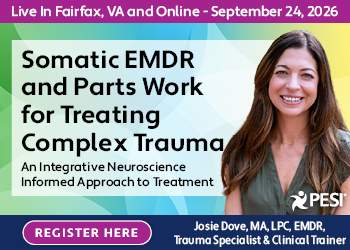
Somatic EMDR and Parts Work for Treating Complex Trauma
An Integrative Neuroscience Informed Approach to Treatment
Join Live
in Fairfax, VA
Join Online
from Anywhere
Meet Your Expert

Josie Dove
Josie Dove, MA, LPC is a Licensed Professional Counselor specializing in complex trauma treatment and integration of EMDR, Sensorimotor Psychotherapy, IFS, and mindfulness-based approaches within a somatic framework.
Josie holds a master's degree in somatic counseling psychology from Naropa University with extensive post-graduate training in EMDR, Internal Family Systems, Sensorimotor Psychotherapy, Applied Polyvagal Theory, and DBT. Her clinical background includes co-creating and serving as lead clinician for the intensive outpatient DBT program at Boulder Community Hospital.
As both clinician and educator, Josie teaches nationally on integrating EMDR with parts work models, nervous system restoration, and somatic body-informed trauma processing. She provides consultation and training for mental health professionals seeking to refine trauma-informed, somatic-based clinical skills.
What You'll Learn
You'll walk away with the tools to:
Gather trauma history and strengthen the preparation phase with increased safety and nervous system awareness
Recognize and work with dissociation and structural fragmentation using parts-informed strategies
Modify EMDR protocols to support stabilization and internal cooperation
Integrate somatic and relational interventions to enhance treatment of complex trauma
Frequently Asked Questions
Have questions?
We have answers.
Yes — this training is designed for licensed mental health professionals including counselors, social workers, psychologists, psychiatrists, therapists, marriage and family therapists, addiction counselors, and physicians. If you work with complex trauma clients, this content is built for you. Click here for Credit details.
Please note: You will have access for 90 days after the program for review. For live CE credit, you must watch the live presentation in its entirety at its scheduled time and complete the CE quiz and evaluation within one week. Please note that this requirement may vary by credit type. Please see detailed credit information for specific requirements for each credit type.
September 24, 2026 from 8–4pm Eastern Time
There will be a 70-minute lunch and two 15-minute breaks; one in the morning and one in the afternoon. Lunch and break times will be announced by the speaker and at their discretion. A more detailed schedule is available upon request.