The Dark Side of the Self-Care Boom: How Consumerism is Fueling Toxic Habits


Over the last decade or so, self-care has become a massive industry. It is everywhere: social media, magazines, TV shows, bus and subway ads. This saturation of self-care in our collective consciousness gives me pause, especially when I see a glossy ad promoting a new wellness product as the latest best thing in self-care. Consumerism-based wellness is fostering a harmful misunderstanding that makes self-care more akin to self-sabotage. I recognized this when my client Maya went from saying how badly she wanted to pare down her professional commitments to musing about how many self-care practices she could fit into her day. “The more healed I become,” she reasoned, “the easier it’ll be for me to say no to unnecessary projects at work.”
When you are struggling with toxic productivity, it becomes easy to see self-care as a means to an end rather than an end in itself. Maya was justifiably looking for fulfillment from things other than work, but because of how deeply toxic productivity was embedded in her mindset, her efforts at self-care had the same effect on her as overworking. In the name of relaxation and recharging, she filled her Sunday mornings with rituals and activities culled from articles and social media videos that were more aspirational than inspirational.
“What if we simplified your self-care?” I proposed. “What if you didn’t do anything? What if you just slept in?”
Maya didn’t hesitate. “I would feel like I wasted my Sunday morning,” she said.
“Why is it a waste to rest your body?” I countered.
“Because it’s lazy, and I don’t want to be a lazy person.”
Bingo. There it was: her intention for self-care was not to care for herself, but to use it to feel good about herself. The items on her self-care list weren’t inherently bad or harmful, but what is harmful is the pressure she put on herself to do them. Without realizing it, she had simply swapped out the environment in which she was practicing toxic habits. Instead of practicing self-care with the goal of feeling good, she was practicing it in order to feel good enough, to achieve an idealized version of herself. Under this kind of pressure, there is almost no winning—only shame and guilt if you don’t do it, and disappointment and criticism if you don’t do it well enough. (And let’s be honest: when does an overachiever ever think they’ve done something well enough?)
If you suspect your self-care habits are a mask for toxic productivity, you can find a way out by becoming attuned to your emotional needs. I nudged Maya to reflect on her feelings before and after the self-care she currently practiced. Were those activities really enjoyable for her? Did they leave her feeling relaxed and ready for the workweek ahead? Or were they only adding to the exhaustion and overwhelm she battled at work?
We listed out every activity in her self-care routine and, next to each activity, wrote down the “should” behind it—what was each of these activities supposed to accomplish for her? If it was a negative “should,” like getting up early to avoid being a lazy person, we crossed it off the list. If it was a positive “should,” such as helping her be playful or experience peace or joy, we considered whether the activity was actually hitting the mark for her. Did 30 minutes of meditation really help her relax? Did she even like those green smoothies she was making? When the activity didn’t hit the mark, we explored things she used to do as a child that gave her that feeling she was seeking. When the activity was hitting the mark, we considered how she could get the same effect from a smaller dose of the activity. For instance, if she did decide to sleep in, maybe taking a long walk to the botanical gardens could be as good as an early morning at the gym and a rushed visit to the farmers’ market.
Nourishing our connection to ourselves is what self-care is really all about. Instead of treating your own needs like just another box to check, try responding to them with the care and attention you’d crave from a loving parent or an attentive partner. Not only will this help you get off the hamster wheel of industrialized self-care so you can save your resources for what really nourishes you, but it can also be the beginning of reclaiming your mindset in all areas of your life.
When you are struggling with toxic productivity, it becomes easy to see self-care as a means to an end rather than an end in itself. Maya was justifiably looking for fulfillment from things other than work, but because of how deeply toxic productivity was embedded in her mindset, her efforts at self-care had the same effect on her as overworking. In the name of relaxation and recharging, she filled her Sunday mornings with rituals and activities culled from articles and social media videos that were more aspirational than inspirational.
“What if we simplified your self-care?” I proposed. “What if you didn’t do anything? What if you just slept in?”
Maya didn’t hesitate. “I would feel like I wasted my Sunday morning,” she said.
“Why is it a waste to rest your body?” I countered.
“Because it’s lazy, and I don’t want to be a lazy person.”
Bingo. There it was: her intention for self-care was not to care for herself, but to use it to feel good about herself. The items on her self-care list weren’t inherently bad or harmful, but what is harmful is the pressure she put on herself to do them. Without realizing it, she had simply swapped out the environment in which she was practicing toxic habits. Instead of practicing self-care with the goal of feeling good, she was practicing it in order to feel good enough, to achieve an idealized version of herself. Under this kind of pressure, there is almost no winning—only shame and guilt if you don’t do it, and disappointment and criticism if you don’t do it well enough. (And let’s be honest: when does an overachiever ever think they’ve done something well enough?)
If you suspect your self-care habits are a mask for toxic productivity, you can find a way out by becoming attuned to your emotional needs. I nudged Maya to reflect on her feelings before and after the self-care she currently practiced. Were those activities really enjoyable for her? Did they leave her feeling relaxed and ready for the workweek ahead? Or were they only adding to the exhaustion and overwhelm she battled at work?
We listed out every activity in her self-care routine and, next to each activity, wrote down the “should” behind it—what was each of these activities supposed to accomplish for her? If it was a negative “should,” like getting up early to avoid being a lazy person, we crossed it off the list. If it was a positive “should,” such as helping her be playful or experience peace or joy, we considered whether the activity was actually hitting the mark for her. Did 30 minutes of meditation really help her relax? Did she even like those green smoothies she was making? When the activity didn’t hit the mark, we explored things she used to do as a child that gave her that feeling she was seeking. When the activity was hitting the mark, we considered how she could get the same effect from a smaller dose of the activity. For instance, if she did decide to sleep in, maybe taking a long walk to the botanical gardens could be as good as an early morning at the gym and a rushed visit to the farmers’ market.
Nourishing our connection to ourselves is what self-care is really all about. Instead of treating your own needs like just another box to check, try responding to them with the care and attention you’d crave from a loving parent or an attentive partner. Not only will this help you get off the hamster wheel of industrialized self-care so you can save your resources for what really nourishes you, but it can also be the beginning of reclaiming your mindset in all areas of your life.
Exercise: Are Your Self-Care Habits Turning Toxic?
Take a few minutes to reflect on your self-care habits. The following list includes some of the signs that you might be using self-care as a disguise for toxic productivity:- Your rules about what self-care should look like are very rigid and restrictive.
- When you don’t engage in self-care practices, you feel ashamed or like a failure.
- The goal of your self-care practice is working toward an imagined ideal self, so you have set high standards and expectations for yourself.
- What type of self-care activities make you feel better? How often do you do these things?
- What are you hoping that self-care gives you?
- How do you feel when you skip self-care? What thoughts come up if you don’t do the self-care activity you had in mind?
Book:
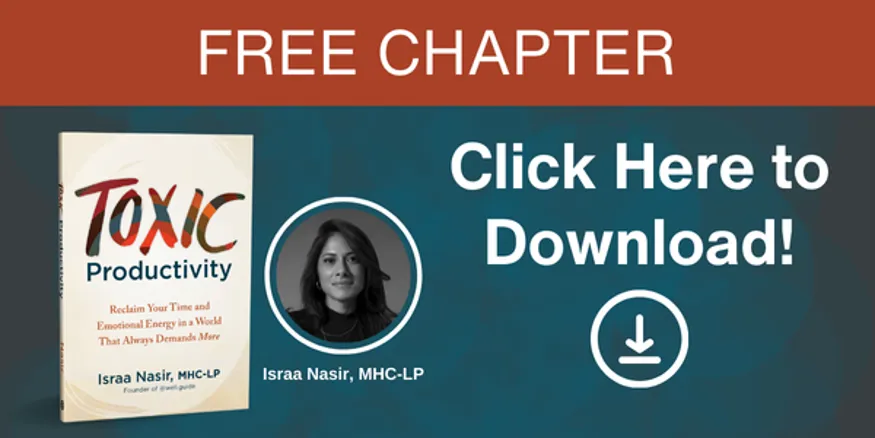
Toxic Productivity: Reclaim Your Time and Emotional Energy in a World That Always Demands More
Toxic Productivity: Reclaim Your Time and Emotional Energy in a World That Always Demands More

In a world obsessed with getting more done, Toxic Productivity unmasks the hidden roots of hustle culture and dismantles the myth that “doing more makes you more worthy.”
In this timely and unsparing guide, psychotherapist and @well.guide founder Israa Nasir offers research-backed insight on dynamics such as self-worth, shame, social comparison, burnout, and perfectionism that keeps us always busy but never satisfied. Nasir gives expert and tangible guidance so you can separate who you are from what you do.
In this timely and unsparing guide, psychotherapist and @well.guide founder Israa Nasir offers research-backed insight on dynamics such as self-worth, shame, social comparison, burnout, and perfectionism that keeps us always busy but never satisfied. Nasir gives expert and tangible guidance so you can separate who you are from what you do.
Topics:

Israa Nasir MHC-LP
Israa Nasir, MHC-LP, is a psychotherapist, writer, and nationally recognized mental health educator specializing in the intersection of emotional well-being and achievement culture. She is the author of Toxic Productivity: Reclaim Your Time and Energy in a World That Always Demands More, a groundbreaking book that unpacks how shame, perfectionism, and over functioning quietly erode mental health – especially in high-achieving adults.
As the founder of Well.Guide, a global mental health platform with over 350,000 followers, Israa has led thousands of people in rethinking the role of productivity in their lives. She is known for translating complex psychological concepts into actionable, relatable guidance, and her work has been featured in Time, Forbes, Harvard Business Review, and Psychology Today.
Drawing from her clinical experience with ambitious, high-performing clients, Israa brings a nuanced, culturally responsive lens to therapy. She helps clinicians understand the hidden emotional toll of overachievement and offers evidence-based interventions to support clients struggling with burnout, people-pleasing, and chronic “doing.”
Through her teaching, Israa blends therapeutic insight, cultural context, and lived experience to create trainings that are emotionally resonant, clinically practical, and deeply human.
As the founder of Well.Guide, a global mental health platform with over 350,000 followers, Israa has led thousands of people in rethinking the role of productivity in their lives. She is known for translating complex psychological concepts into actionable, relatable guidance, and her work has been featured in Time, Forbes, Harvard Business Review, and Psychology Today.
Drawing from her clinical experience with ambitious, high-performing clients, Israa brings a nuanced, culturally responsive lens to therapy. She helps clinicians understand the hidden emotional toll of overachievement and offers evidence-based interventions to support clients struggling with burnout, people-pleasing, and chronic “doing.”
Through her teaching, Israa blends therapeutic insight, cultural context, and lived experience to create trainings that are emotionally resonant, clinically practical, and deeply human.
Speaker Disclosures:
Financial: Israa Nasir has an employment relationship with Anise Health. She receives royalties as a published author. Israa Nasir receives a speaking honorarium and book royalties from PESI, Inc. She has no relevant financial relationships with ineligible organizations.
Non-financial: Israa Nasir has no relevant non-financial relationships.
You May Also Be Interested In These Related Blog Posts


